 By Muhammad Talha
An H-1B visa does not turn into a green card on its own. It can lead to one — but only through a separate, employer-driven process that usually takes years: a prevailing wage determination, a PERM labor certification, an I-140 immigrant petition, and then a wait for your priority date to become current in the Visa Bulletin before you can file Form I-485. When the date is already current, the I-485 can instead be filed together with the I-140, or while the I-140 is still pending. This guide walks through every stage in order, with the real 2026 fees from the USCIS fee schedule, the real processing times from the Department of Labor, the November 2026 Visa Bulletin dates, and the AC21 rules that let you stay and work in the United States while you wait.
The single most important fact in this guide: for workers born in India, the employment-based queue is measured in years, not months. In the November 2026 Visa Bulletin, the EB-2 final action date for India is November 1, 2013, and EB-3 is January 22, 2014. Everything in this guide — the stages, the fees, the AC21 extensions — exists because of that wait.
In this guide
- Does H-1B lead to a green card?
- The full pathway, step by step
- How long does it take?
- What does it cost?
- EB-2 vs EB-3 vs EB-1 vs NIW — which category?
- The Visa Bulletin and your priority date
- AC21: staying in the U.S. while you wait
- Filing I-485 vs consular processing
- Working and traveling while I-485 is pending
- What can go wrong
- Do the 2026 changes affect your green card?
- Your checklist
- Frequently Asked Questions
- Sources
Does H-1B lead to a green card?
Yes — but the H-1B itself never converts. Holding H-1B status does not block you from seeking permanent residence, and it does not start the clock either. A green card comes from a separate immigrant petition, and in the usual employer-sponsored route there are two different petitions from two different agencies: the employer first proves to the Department of Labor that no qualified U.S. worker is available for the job (the PERM labor certification), and then files Form I-140 with USCIS to classify you in an employment-based category. When your priority date becomes current, you can file for the green card itself — and if it is already current, the I-485 can be filed together with the I-140, or while the I-140 is still pending (concurrent filing, explained below).
There are two exceptions to the employer-driven route. Workers with extraordinary ability (EB-1A) and workers whose work is in the national interest (EB-2 National Interest Waiver) can self-petition — no employer, no job offer, and no PERM. They still wait in the Visa Bulletin queue like everyone else. The categories are compared in EB-2 vs EB-3 vs EB-1 vs NIW below.
This guide covers the employment-based route only — the path an H-1B worker actually takes. It does not cover family-based green cards, asylum, or the diversity visa lottery.
The full pathway, step by step
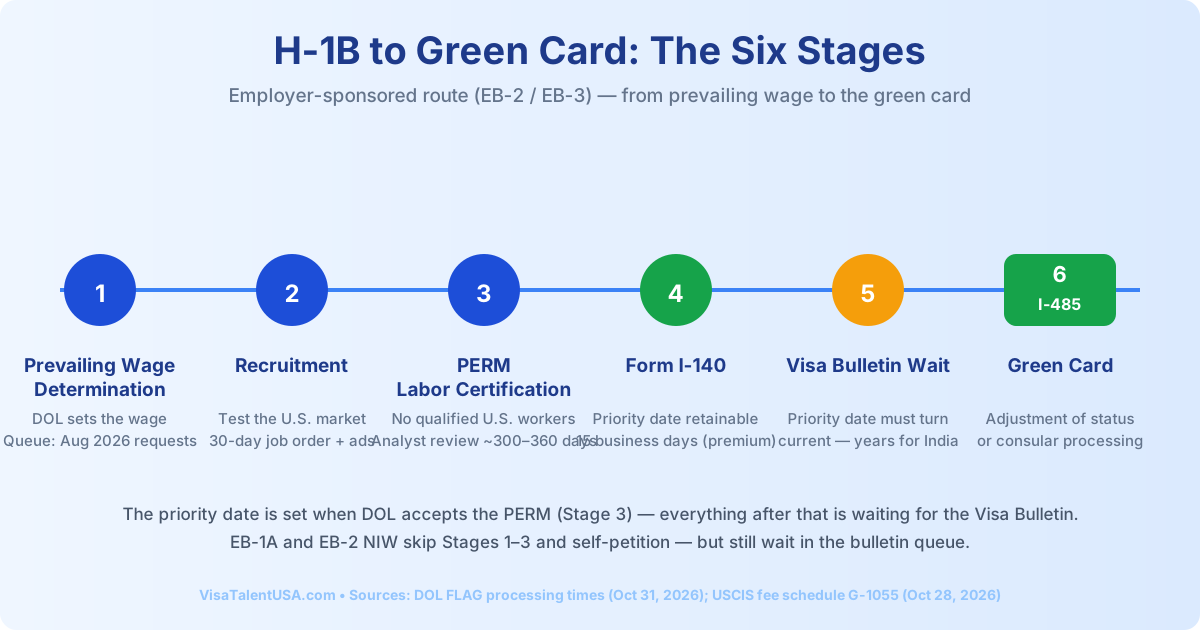
The employer-sponsored route (EB-2 or EB-3) has six stages. Each stage has a different filer, a different agency, and a different purpose. A failure at any stage before the I-140 is approved means starting over. The priority date is established when the Department of Labor accepts the PERM application for processing — and it is retained for a later petition only once an I-140 is approved, subject to the exceptions in 8 CFR 204.5(e).
| Stage | What happens | Who files | Government fee |
|---|---|---|---|
| 1. Prevailing Wage Determination (PWD) | DOL sets the minimum wage for the occupation in the area of employment (Form ETA-9141) | Employer, to DOL | $0 |
| 2. Recruitment | Employer tests the U.S. labor market — job order, newspaper ads, and additional steps | Employer | $0 |
| 3. PERM labor certification | DOL certifies no qualified U.S. workers are available (Form ETA-9089) | Employer, to DOL | $0 |
| 4. Form I-140 | Immigrant petition; an approved I-140 retains the priority date for later petitions | Employer (or worker, for EB-1A / NIW) | $715 paper / $665 online, plus Asylum Program Fee |
| 5. Visa Bulletin wait | Wait for the priority date to become current; the wait is years long for India and China | — | $0 |
| 6. Green card | Form I-485 adjustment of status in the U.S., or consular processing abroad | Worker (and derivatives) | $1,440 paper / $1,390 online (I-485) |
Stage 1 — Prevailing Wage Determination (PWD)
The employer files Form ETA-9141 with the Department of Labor’s National Prevailing Wage Center through the FLAG system. DOL sets the prevailing wage for the occupation in the area of employment, usually from the Occupational Employment and Wage Statistics (OEWS) survey, under 20 CFR 656.40. The wage offered in recruitment and on the PERM application must be at least the prevailing wage. A PWD is valid for at least 90 days and no more than one year. There is no government fee for a PWD.
Stage 2 — Recruitment
The employer must test the U.S. labor market under 20 CFR 656.17. For a professional occupation, that means a 30-day job order with the state workforce agency, two Sunday newspaper advertisements, and three additional recruitment steps chosen from the regulation’s list. The core steps must take place at least 30 days and no more than 180 days before the PERM is filed. The point is to establish that there are no able, willing, qualified, and available U.S. workers for the job. The employer pays the recruitment and attorney costs — 20 CFR 656.12(b) bars passing PERM costs to the worker.
Stage 3 — PERM labor certification
The employer files Form ETA-9089 through DOL’s FLAG system. Electronic filing began June 1, 2023, and DOL’s instructions also permit submission by mail (postmarked June 1, 2023 or later). The Department of Labor certifies two things under INA 212(a)(5)(A): that no qualified U.S. workers are available, and that hiring the foreign worker will not adversely affect the wages and working conditions of similarly employed U.S. workers. DOL can certify, deny, or audit the case — an audit means DOL demands the full recruitment file, and it adds many months. There is no government fee for a PERM. A certified PERM is valid for 180 days: the I-140 must be filed within 180 days of certification, or the PERM expires.
Stage 4 — Form I-140
The employer files Form I-140, Immigrant Petition for Alien Workers, with USCIS. This is the step that makes the priority date retainable: for PERM-based cases, the priority date was already established when DOL accepted the ETA-9089 for processing (8 CFR 204.5(d)); for cases without a PERM, it is the date USCIS properly receives the I-140. The priority date is your place in the Visa Bulletin queue, and it never moves forward by itself — the queue moves toward it. Once the I-140 is approved, the date can be retained for a later petition under 8 CFR 204.5(e), subject to the exceptions explained in the AC21 section below. Premium processing is available and is covered in How long does it take?.
Stage 5 — The Visa Bulletin wait
Once the I-140 is filed, the priority date is already in the queue — it was set when DOL accepted the PERM. If the date is current under the chart USCIS designates, the I-485 can be filed together with the I-140 or while it is still pending; if it is not current, the wait begins. The State Department publishes the Visa Bulletin every month with two charts — Final Action Dates and Dates for Filing — and your date must be earlier than the listed cutoff. For workers born in India or China, this is the longest stage by far: the November 2026 bulletin shows EB-2 India at November 1, 2013. The bulletin is explained in full in The Visa Bulletin and your priority date.
Stage 6 — Form I-485 or consular processing
Once the priority date is current, the worker applies for the green card itself — Form I-485 (adjustment of status) from inside the United States, or consular processing through the National Visa Center and a U.S. consulate from abroad. While an I-485 is pending, the worker can apply for an Employment Authorization Document and Advance Parole. The two routes are compared in Filing I-485 vs consular processing.
How long does it take?
There is no single official answer to “how long from H-1B to green card,” because the stages are measured by different agencies and the bulletin wait depends on your country of birth. What can be stated precisely is how long each stage takes right now, from the agencies’ own figures. The table below is current as of October 31, 2026.
| Stage | Current figure | Source |
|---|---|---|
| Prevailing Wage Determination | DOL was processing PERM PWD requests received in August 2026 (OEWS survey) and July 2026 (non-OEWS) | DOL FLAG, Oct 31, 2026 |
| PERM analyst review (ETA-9089) | 300 calendar days (cases decided in the last 30 days); 315 days (last 90 days); 360 days (last 180 days) | DOL FLAG, Oct 31, 2026 |
| Recruitment | 30-day state job order plus ads; core steps must fall 30 to 180 days before the PERM is filed | 20 CFR 656.17 |
| I-140, premium processing | 15 business days (EB-1A, EB-1B, PERM-based EB-2 and EB-3); 45 business days (EB-1C and NIW) | 8 CFR 106.4; 91 FR 1059 |
| I-140, regular processing | No single figure — times vary by category and service center and change monthly | USCIS Case Processing Times tool |
| I-485 / EAD / Advance Parole | No fixed official figure — check the USCIS processing times tool at filing time | USCIS Case Processing Times tool |
Putting the official stage figures together gives a realistic sense of the pre-bulletin stretch: roughly three months in the PWD queue, one to three months of recruitment, about ten to twelve months of PERM analyst review, and fifteen business days for a premium-processed I-140 — around a year and a half of processing before the green card itself can be filed. But that is not a separate wait followed by another wait: the priority-date queue runs from PERM acceptance, so the processing time and the bulletin wait overlap — while the PERM and I-140 are being processed, the queue is already moving. That is arithmetic from the agencies’ own stage figures, not an official total, and a PERM audit can add many months on top of it. DOL publishes no separate average for audit cases.
Two things about premium processing are often misunderstood. First, the 15-business-day clock guarantees an action — an approval, a denial, a Request for Evidence, or a Notice of Intent to Deny — not an approval. Second, an RFE or NOID stops the clock, and a new full period starts when USCIS receives the response. Premium processing buys speed, not a result. For the bulletin wait itself, no processing time applies at all — the wait is set by the Visa Bulletin, covered in The Visa Bulletin and your priority date.
What does it cost?
Every fee below is from the USCIS Fee Schedule (Form G-1055, last updated October 28, 2026) and the regulation behind it, 8 CFR 106.2. Paper fees are verified in the eCFR; online fees were verified directly on the USCIS fee schedule. PWD and PERM have no government fee at all — the employer’s cost there is recruitment and attorney fees, which the law bars passing to the worker.
| Item | Paper filing | Online filing | Notes |
|---|---|---|---|
| Prevailing Wage Determination (ETA-9141) | $0 | $0 | No government fee |
| PERM labor certification (ETA-9089) | $0 | $0 | No government fee |
| Form I-140 | $715 | $665 | Plus Asylum Program Fee below |
| Asylum Program Fee (with every I-140) | $600 / $0 / $300 | $600 / $0 / $300 | $600 regular petitioner; $0 nonprofit; $300 small employer (25 or fewer employees) or self-petitioner |
| Form I-485, age 14 and over | $1,440 | $1,390 | No separate biometrics fee |
| Form I-485, child under 14 filing with a parent | $950 | $900 | Concurrent filing with a parent’s I-485 |
| Form I-765 (EAD) with a pending I-485 | $260 | $260 | Standalone I-765 is $520; $0 only if the I-485 was filed July 30, 2007 to April 1, 2024 with the fee paid |
| Form I-131 (Advance Parole) with a pending I-485 | $630 | $580 | Part 1, Item 5.A. on Form I-131 |
| Form I-485 Supplement J (job portability) | $0 | $0 | No fee, 8 CFR 106.2(a)(23) |
| Premium processing (Form I-907, I-140) | $2,965 | $2,965 | Paid separately, in addition to all other fees; effective March 1, 2026 (91 FR 1059) |
| USCIS Immigrant Fee (consular route) | $235 | $235 | Paid to USCIS after the immigrant visa is issued |
| Immigrant visa fee (consular route) | $345 per person | — | State Department fee (22 CFR 22.1); not a USCIS fee |
Worked examples — one adult, employer-sponsored
Paper filing: I-140 $715 + Asylum Program Fee $600 = $1,315; then I-485 $1,440 + I-765 $260 + I-131 $630 = $2,330. Total government fees: $3,645. With premium processing ($2,965): $6,610.
Online filing: I-140 $665 + Asylum Program Fee $600 = $1,265; then I-485 $1,390 + I-765 $260 + I-131 $580 = $2,230. Total government fees: $3,495. With premium processing: $6,460.
Self-petitioner (EB-1A or NIW), paper filing: I-140 $715 + Asylum Program Fee $300 = $1,015; then $2,330 for the I-485 stage. Total: $3,345 before premium processing.
Attorney fees are separate from every figure above, and there is no official range for them — this guide does not quote one. The H-1B petition fees from the earlier stages of your immigration journey (the I-129 filing fee, the ACWIA fee, the fraud prevention fee) are not green-card fees and are not in this table; they are covered in our H-1B visa cost guide.
EB-2 vs EB-3 vs EB-1 vs NIW — which category?
The category decides three things: whether a PERM is needed, whether you can self-petition, and which Visa Bulletin queue you wait in. Most H-1B workers go through EB-2 or EB-3 with their employer. EB-1 and the National Interest Waiver skip the PERM entirely, but they have much higher eligibility bars.
| Category | Who qualifies | Who files the I-140 | PERM needed? | Self-petition? |
|---|---|---|---|---|
| EB-2 (standard) | Advanced degree (master’s or higher, or bachelor’s plus five years of progressive experience) or exceptional ability in the sciences, arts, or business (3 of 6 criteria, 8 CFR 204.5(k)) | U.S. employer | Yes | No |
| EB-3 | Skilled workers (job needs two or more years of training or experience), professionals (bachelor’s degree), or “other workers” (unskilled, under two years) | U.S. employer | Generally yes — Schedule A occupations (physical therapists, professional nurses) are pre-certified by DOL and skip the ordinary PERM process | No |
| EB-1A — Extraordinary Ability | Sustained national or international acclaim; a major one-time award or 3 of 10 criteria (8 CFR 204.5(h)), plus a final merits determination | Worker | No | Yes — no job offer, no employer |
| EB-1B — Outstanding Professor / Researcher | International recognition; 2 of 6 criteria (8 CFR 204.5(i)); at least three years of teaching or research experience; permanent research or tenure-track offer | U.S. employer (university or research institution) | No | No — job offer required |
| EB-1C — Multinational Manager / Executive | Employed abroad at least one year in the last three years in a managerial or executive capacity by a qualifying related entity; coming to a managerial/executive role (8 CFR 204.5(j)) | U.S. company in the corporate group | No | No — employer-driven |
| EB-2 NIW — National Interest Waiver | First qualifies under EB-2, then meets the three Dhanasar prongs: the proposed endeavor has substantial merit and national importance; the petitioner is well positioned to advance it; and waiving the job offer and labor certification benefits the U.S. (Matter of Dhanasar, 26 I&N Dec. 884 (AAO 2016)) | Worker | No — waived | Yes — no job offer, no employer |
The point most often missed: skipping the PERM does not skip the Visa Bulletin queue. An NIW is still an EB-2 petition, so an Indian-born NIW beneficiary waits in the same EB-2 India line (final action date November 1, 2013). The real queue advantage is EB-1: in November 2026, EB-1 India stands at February 1, 2023, EB-1 China at August 1, 2023, and EB-1 for the rest of the world is current. That is why EB-1A and EB-1C are worth understanding even if you start in EB-2 or EB-3 — and why they are hard to qualify for.
The Visa Bulletin and your priority date
Your priority date is your place in line. For PERM-based cases it is the date the Department of Labor accepted your ETA-9089 for processing; for cases without a PERM it is the date USCIS properly received your I-140. The State Department publishes the Visa Bulletin every month, and your priority date must be earlier than the date listed for your category and country of birth. “C” means current — no wait.
There are two charts, and they do different jobs. Final Action Dates decide when a visa number is actually available — when a green card can be approved or an immigrant visa issued. Dates for Filing are an earlier cutoff that lets applicants assemble documents and file Form I-485 sooner, when USCIS allows it. For consular processing, Final Action Dates govern when the immigrant visa can actually be issued — but Dates for Filing still matter: they tell the National Visa Center when to start collecting the applicant’s documents.
| Category — Final Action Dates | Rest of World | China (mainland-born) | India |
|---|---|---|---|
| EB-1 | Current | Aug 1, 2023 | Feb 1, 2023 |
| EB-2 | Apr 1, 2025 | Oct 1, 2021 | Nov 1, 2013 |
| EB-3 | Jun 15, 2024 | Jan 22, 2022 | Jan 22, 2014 |
| EB-3 Other Workers | Jun 1, 2022 | Oct 1, 2019 | Jan 22, 2014 |
| Category — Dates for Filing | Rest of World | China (mainland-born) | India |
|---|---|---|---|
| EB-1 | Current | Jul 1, 2024 | Jul 1, 2024 |
| EB-2 | Mar 15, 2026 | Jan 1, 2023 | Jan 15, 2015 |
| EB-3 | Aug 1, 2024 | Apr 1, 2024 | Jan 15, 2015 |
| EB-3 Other Workers | Jul 1, 2022 | Oct 1, 2020 | Jan 15, 2015 |
Movement in November 2026: EB-2 India held at November 1, 2013. EB-3 India advanced 21 days, from January 1 to January 22, 2014 — which means EB-3 India is now later than EB-2 India, a detail that matters for workers considering an EB-2 to EB-3 downgrade (a second I-140 in EB-3 while keeping the earlier priority date). EB-2 for the rest of the world advanced three months (January 1 to April 1, 2025); EB-3 for the rest of the world advanced one month; EB-3 China advanced two weeks. No employment-based category retrogressed in November.
Which chart do you use to file I-485 in November 2026? USCIS directs applicants in all family-sponsored and all employment-based preference categories to use the Dates for Filing chart for November 2026. That instruction comes from the USCIS Adjustment of Status Filing Charts page, as reported in multiple summaries of the page; the page itself could not be read directly during our research, so confirm the current month’s chart on uscis.gov /visabulletininfo before filing. The bulletin itself states the default is Final Action Dates unless USCIS indicates otherwise.
Why the wait is so long for India and China: the Immigration and Nationality Act sets the employment-based worldwide level at 140,000 visas a year (INA 203(b)) and caps any one country at 7% of the family and employment preference limits (INA 202). Demand from India and China far exceeds that share, so the queue stretches for years. The bulletin moves in small steps — weeks and months, not years — and it can move backwards (retrogress). A pending I-485 is not denied by retrogression; it waits, and it cannot be approved until the date advances past your priority date again.
Track your own date with our Priority Date Tracker and read the month-by-month breakdown in our November 2026 Visa Bulletin guide.
AC21: staying in the U.S. while you wait
The H-1B visa is capped at six years in total (INA 214(g)(4)). Without AC21 — the American Competitiveness in the Twenty-First Century Act of 2000 — a worker whose priority date is still years away would have to leave. AC21 provides the only extensions past the six-year limit, and the only way to change employers mid-process without starting over. The employer filing the H-1B extension does not have to be the employer that filed the PERM or I-140.
One-year extensions — PERM or I-140 pending 365 days
Under AC21 §106(a) and 8 CFR 214.2(h)(13)(iii)(D), an H-1B worker can extend in increments of up to one year when a PERM labor certification application or an employment-based I-140 was filed at least 365 days before the six-year limit would hit, and no final decision (denial) has been made. The filing does not need to have been pending for the whole 365 days. This covers EB-1, EB-2, and EB-3 petitions, including self-petitioned EB-1A and NIW I-140s.
There is a trap in the same rule, 8 CFR 214.2(h)(13)(iii)(D)(10): once an immigrant visa has been available — that is, once your priority date has been current — for one year and you have not filed for adjustment of status or an immigrant visa, the post-sixth-year extension is no longer available, unless USCIS excuses the delay. Do not let a current priority date sit unused for a year.
Three-year extensions — approved I-140, backlogged date
Under AC21 §104(c) and 8 CFR 214.2(h)(13)(iii)(E), a worker can extend in increments of up to three years when they are the beneficiary of an approved EB-1, EB-2, or EB-3 I-140 and are eligible for permanent residence except that an immigrant visa is unavailable because of the per-country limits — in other words, the priority date is not current. There is no 365-day requirement. The extension is renewable indefinitely while the I-140 remains approved and the date stays backlogged, and visa unavailability is assessed as of the date the H-1B petition is filed. For most Indian-born workers with an approved I-140, this is the extension that carries them through the wait.
Changing jobs — portability after 180 days
Under INA 204(j) and 8 CFR 245.25, once a properly filed I-485 has been pending 180 days or more, the applicant may move to a new job — same or different employer, or self-employment — in the same or a similar occupational classification, without a new PERM or I-140. The underlying I-140 must be approved, or pending and later approved (it must have been approvable when filed and remain so until the I-485 hit 180 days). The new job must be a genuine, full-time, permanent offer the applicant intends to accept. Portability is requested on Form I-485 Supplement J, which has no fee — but a Supplement J filed before day 180 will be rejected. EB-1A and NIW applicants do not need Supplement J, because no job offer underlies their cases. “Same or similar” is judged on duties, skills, education and experience, wage, and SOC code. The 180 days are calendar days, counted from the proper filing of the I-485 until USCIS receives the portability request.
Keeping your priority date
Under 8 CFR 204.5(e), an approved EB-1, EB-2, or EB-3 petition’s priority date can be carried to any later EB-1, EB-2, or EB-3 petition, and with multiple approved petitions the worker keeps the earliest date. Retention survives employer withdrawal and business closure. It is lost only if the approval is revoked for fraud or willful misrepresentation of a material fact, a revoked or invalidated labor certification, or a material error in the approval.
A related but separate rule, 8 CFR 205.1, governs what happens to the petition itself when an employer withdraws it. A withdrawal less than 180 days after I-140 approval — and before the I-485 has been pending 180 days — automatically revokes the petition. A withdrawal 180 or more days after approval, or after the I-485 has been pending 180 days, does not automatically revoke it, so the approved petition still supports AC21 H-1B extensions and portability. And losing the petition is not the same as losing the priority date: the date is retained even after an automatic revocation (except for the fraud, labor certification, and material-error exceptions), but a new employer must still file a new PERM and I-140 to use it — unless the worker ports to a same or similar job under INA 204(j) after the I-485 has been pending 180 days, which needs no new PERM or I-140.
Filing I-485 vs consular processing
Once the priority date is current, there are two ways to get the green card. Which one applies depends on where you are — and only the I-485 route comes with work and travel documents while you wait.
| Form I-485 (adjustment of status) | Consular processing | |
|---|---|---|
| Where | Inside the United States | Abroad, via the National Visa Center and a U.S. consulate |
| Government fees | $1,440 paper / $1,390 online (age 14+); $950 / $900 (child under 14 with a parent) | $345 per person immigrant visa fee + $235 per person USCIS Immigrant Fee |
| Work and travel while waiting | EAD (Form I-765, $260) and Advance Parole (Form I-131, $630 paper / $580 online) | None — no EAD or Advance Parole |
| Concurrent filing with I-140 | Only when the priority date is current under the chart USCIS designates that month | Not applicable |
| If the I-140 is denied | A concurrently filed I-485 is denied as well | No immigrant visa can issue |
| End of the process | Green card approved by USCIS in the U.S. | Immigrant visa issued (normally valid up to 6 months); green card produced after the $235 fee is paid |
Concurrent filing — filing the I-140 and the I-485 together — is only possible when the priority date is current under the chart USCIS designates for that month (for November 2026, the Dates for Filing chart). For most Indian- and Chinese-born EB-2 and EB-3 workers, the date is not current at I-140 time, so concurrent filing is usually unavailable until years later. It is routinely available for rest-of-world EB-2 and EB-3 cases and for EB-1. If a concurrently filed I-140 is denied, the I-485 loses its basis and is denied too.
Working and traveling while I-485 is pending
A pending I-485 supports two documents that change daily life immediately: an Employment Authorization Document (EAD) and Advance Parole. Both are useful, and both carry a catch that is easy to get wrong.
The EAD — work for any employer, with a catch
A pending I-485 supports a category (c)(9) EAD (Form I-765, $260), which authorizes work for any employer — unlike the H-1B, which ties you to the petitioning employer and job. But the EAD is only as durable as the I-485: if the I-485 is denied, EAD-based work authorization ends with it, and a worker who has left H-1B status has no nonimmigrant status to fall back on. Merely holding an unused EAD does not end H-1B status; using it to work — for a different employer, or after re-entering on Advance Parole — does. That hold-versus-use distinction is USCIS guidance, not a regulation text. The practical advice given consistently is to keep H-1B status as a safety net while the I-485 is pending if possible, especially before the 180-day portability mark.
Advance Parole — travel without abandoning your case
Departing the United States while an I-485 is pending without prior Advance Parole is deemed abandonment of the I-485 (8 CFR 245.2(a)(4)(ii)(A)). Advance Parole (Form I-131, $630 paper / $580 online) authorizes return without abandoning the case. There is an exception for H-1B and L-1 holders (8 CFR 245.2(a)(4)(ii)(C)): an applicant in valid H-1B (or H-4, L-1, L-2, K-3, or K-4) status who departs and returns on a valid H or L visa to resume the same employment does not abandon the I-485 and does not need Advance Parole — but needs a valid visa stamp for re-entry. Re-entering on Advance Parole instead admits the person as a parolee, not in H-1B status. They may keep working for the same H-1B employer without an EAD, and can regain H-1B status through a later extension or transfer petition — but if they then work on the EAD or change employers on the EAD, H-1B status is lost.
One newer cost to know: the USCIS fee schedule lists an additional $1,050 Immigration Parole Fee (Pub. L. 119-21), collected by U.S. Customs and Border Protection each time you seek parole at a port of entry, unless CBP determines you qualify for an exception. Budget for it before traveling on Advance Parole.
A further caution from 2026: on August 13, 2026, the Board of Immigration Appeals held in Matter of Delcarmen-Lara, 29 I&N Dec. 830 (Interim Decision #4233), that a departure on Advance Parole is a “departure” for purposes of the ten-year unlawful presence bar, INA 212(a)(9)(B)(i)(II) — the bar that applies to people with one year or more of unlawful presence who seek admission within ten years of departure. The decision overrules the prior Arrabally rule, and applies prospectively — the Board applied its holding prospectively under the retroactivity test in Matter of Cordero-Garcia, 27 I&N Dec. 652, 658 (BIA 2019), and declined to decide whether the respondent’s own January 2024 trip triggered the bar. It does not address the three-year bar in clause (i)(I), so the two bars should not be merged. Anyone with unlawful presence history should get advice before traveling on Advance Parole. The holding and its prospective application are verified against the official decision (U.S. Department of Justice, EOIR, Interim Decision #4233, Section II.B).
What can go wrong
Most green-card cases that fail do so at a predictable point. Knowing the failure point in advance is what lets you avoid it.
| Risk | What happens | What to do |
|---|---|---|
| PERM audit | DOL demands the full recruitment file; supervised recruitment may follow. No separate DOL average is published for audit cases; audits add many months. A failed audit means denial. | Meticulous recruitment documentation; respond fully and on time. |
| PERM denial | No certified labor certification, so no I-140 can be filed on it. The priority date was set when DOL accepted the ETA-9089, but without an approved I-140 it is not retained — so it is lost in practice. | Employer may request reconsideration or review, or re-file — restarting the clock. |
| I-140 denial | Without an approved petition, the priority date established by the PERM is not retained, and there is no I-485 basis — a concurrently filed I-485 is denied as well. AC21 extensions are a separate question: a one-year extension may still be available on a qualifying PERM or I-140 filed 365 or more days ago that has not been finally denied (a denial under appeal or reconsideration may not count as final); the three-year extension requires an approved I-140. | Premium processing changes only the speed of the first action, not the outcome. |
| Priority-date retrogression | The Final Action Date moves backwards after filing. A pending I-485 is not denied — it waits, and cannot be approved until the date advances past the priority date again. EAD and Advance Parole remain renewable while it pends. | Filing under Dates for Filing does not protect against retrogression of the Final Action Date. |
| Changing employers / laid off mid-process | If no I-485 has been pending 180 days: a job change does not by itself end the original case — it can continue if the original employer’s permanent job offer and your intent to accept it remain. If the original employer withdraws the permanent job offer and INA 204(j) portability is unavailable, a new employer generally needs a new PERM and I-140 for the standard employer-sponsored route (a date from an approved I-140 would be retained). If the I-485 has been pending 180 days: portability to a same or similar job via Supplement J, even if the I-140 is still pending, provided it is later approved. | File the I-485 as soon as the date allows; do not resign before day 180 without advice. A layoff on H-1B also triggers the 60-day grace period. |
| Employer withdraws the I-140 | Less than 180 days after approval (and I-485 pending less than 180 days): automatic revocation. 180 or more days after approval, or after the I-485 has been pending 180 days: the petition remains approved for AC21 and portability purposes. | The priority date is retained either way (except for fraud, labor certification, and material-error revocations) — a new employer files a new PERM and I-140 to use it. |
| Traveling abroad while I-485 is pending without Advance Parole | Deemed abandonment of the I-485 — unless the H-1B / L-1 exception applies (valid status, valid visa, return to the same employer). Re-entering on Advance Parole makes you a parolee, not an H-1B holder. | Get Advance Parole before departing. H-1B holders should prefer re-entry on the H-1B visa and keep Advance Parole as a backup. |
Do the 2026 changes affect your green card?
Three 2026 developments touch the H-1B world. None of them changes a green-card step today — but one of them could make the AC21 extensions harder, and one could raise future PERM wages.
The $100,000 H-1B fee — no effect on the green-card path
Proclamation 10973 (September 19, 2025) imposed a $100,000 payment as a condition for certain new H-1B petitions filed on or after September 21, 2025, principally for workers abroad; Proclamation 11069 (September 18, 2026) extended it to September 21, 2027. It is blocked by the courts and is not being collected: the District of Massachusetts vacated the implementing guidance on June 8, 2026, the First Circuit denied a stay on July 24, 2026, and the Northern District of California blocked implementation policies on September 30, 2026, with appeals pending. It is not a fee on PERM, I-140, I-485, extensions, amendments, or change-of-employer petitions for workers already in the United States, and it does not change any green-card step. The full status is tracked on our $100K fee status page. The court and proclamation details in this paragraph are drawn from secondary sources citing USCIS, White House, and court records.
The deference proposal — the one to watch
The Department of Homeland Security’s proposal to end deference on H-1B extensions (91 FR 65119, October 14, 2026, docket USCIS-2026-0529) would delete 8 CFR 214.1(c)(5), the rule that currently requires USCIS to defer to its prior eligibility determination when adjudicating an I-129 involving the same parties and the same underlying facts. Comments closed on November 13, 2026. It is a proposal only: the current deference rule remains in force until a final rule publishes and takes effect. If finalized, every H-1B extension — including AC21 one-year and three-year extensions past the six-year limit — would be re-examined from scratch. DHS estimates about 208,429 petitions a year would lose deference and about 6,044 additional RFEs a year would result. The green-card steps themselves (PERM, I-140, I-485) are unaffected. Read the full analysis in our H-1B extension deference guide.
The prevailing-wage final rule — not in effect
The Department of Labor’s prevailing-wage final rule, “Improving Wage Protections for the Temporary and Permanent Employment of Certain Foreign Nationals in the United States” (RIN 1205-AC30), was submitted to White House OIRA review as a final rule on November 6, 2026. It is not published, not effective, and its final text is not public. The proposed version (91 FR 15454, March 27, 2026) would raise wage levels for H-1B, H-1B1, E-3, and PERM: Level I from the 17th to the 34th percentile, Level II from the 34th to the 52nd, Level III from the 50th to the 70th, and Level IV from the 67th to the 88th. The final percentiles may differ. As proposed, the rule would apply to wage requests pending on the effective date and to new requests and LCAs filed on or after it — not to previously issued determinations, certified PERMs, or filed LCAs. Its effect on the green-card path today is none: current PWDs are still issued under 20 CFR 656.40. If finalized as proposed, future PERM cases would face higher offered-wage requirements. Separately, DOL’s PERM labor-market-test proposal (RIN 1205-AC29) cleared OIRA review on October 23, 2026, but is unpublished; the current recruitment rules at 20 CFR 656.17 still apply. The OIRA status in this paragraph is as reported by APLU (November 11, 2026) and Immigration Analytics (November 9, 2026), citing reginfo.gov.
Your checklist
If you are on H-1B today and want a green card, this is the order of operations:
- Start the conversation with your employer early. The PERM stage alone takes over a year from PWD to certified labor certification. The 365-day clock for AC21 one-year extensions starts when the PERM or I-140 is filed, so every month of delay is a month of flexibility lost.
- Keep H-1B status as long as possible. Do not resign before your I-485 has been pending 180 days without advice, and do not use an EAD to change employers before that mark — the safety net is worth more than the flexibility.
- File the I-485 as soon as the bulletin allows. Do not let a current priority date sit unused for a year; the AC21 one-year-extension trap in 8 CFR 214.2(h)(13)(iii)(D)(10) can cost you the extension.
- Get Advance Parole before any trip abroad while an I-485 is pending — unless you will re-enter on a valid H-1B visa to the same employer — and prefer re-entry on your H-1B visa. Budget for the $1,050 CBP parole fee if you travel on Advance Parole.
- Keep copies of every filing — the PERM, the I-140 approval notice, and your priority date. The date survives employer changes; the paperwork is what proves it.
- Check the bulletin every month with our Priority Date Tracker, and check the USCIS processing-times tool before quoting any timeline to yourself or your employer.
- If your employer ends sponsorship, know your options before you act: an H-1B transfer to a new employer, an EB-1A or NIW self-petition, or the 60-day grace period — see our 60-day grace period guide.
- Talk to an immigration attorney before any job change, before traveling with any unlawful-presence history, or if your I-140 is withdrawn. This guide is information, not legal advice.
Frequently Asked Questions
Does H-1B lead to a green card?
Yes, but the H-1B itself never converts. Your employer must sponsor you through PERM labor certification and an I-140 petition, and then you wait for your priority date to become current in the Visa Bulletin before filing Form I-485. Workers with extraordinary ability (EB-1A) or a national interest waiver (EB-2 NIW) can self-petition instead.
How long does it take from H-1B to green card?
There is no single official figure. The PWD, recruitment, PERM and I-140 processing — about three months in the PWD queue, one to three months of recruitment, about ten to twelve months of PERM review, and fifteen business days for a premium-processed I-140 — adds up to roughly a year and a half from the agencies’ own figures. But that is not a separate wait followed by another wait: the priority-date queue runs from PERM acceptance, so the processing and the queue overlap — while the PERM and I-140 are being processed, the queue is already moving. The bulletin wait then dominates: in November 2026, EB-2 India stands at November 1, 2013 and EB-3 India at January 22, 2014.
How much does a green card cost from H-1B?
For one adult, employer-sponsored: $3,645 in government fees by paper ($3,495 online) — I-140 with the Asylum Program Fee plus I-485, I-765, and I-131. Premium processing adds $2,965. A self-petitioner (EB-1A or NIW) pays $3,345 by paper. Attorney fees are separate and there is no official range for them.
Can I apply for a green card without my employer?
For EB-2 and EB-3, no — the employer must file the PERM and the I-140. For EB-1A (extraordinary ability) and EB-2 NIW (national interest waiver), yes — you can self-petition with no job offer and no PERM. An NIW is still an EB-2 petition, so it waits in the EB-2 queue.
Can I change jobs during the green card process?
Eligible H-1B workers may change employers through a qualifying new petition — an H-1B transfer — subject to the portability conditions. What changes is whether your green-card case survives. If no I-485 is pending yet, a job change does not by itself end the original case — it can continue if the original employer’s permanent job offer and your intent to accept it remain. But if the original employer withdraws the offer and INA 204(j) portability is unavailable, the new employer starts over with a new PERM and I-140 (an approved I-140’s priority date is retained for the new petition). If the I-485 has already been pending 180 days, AC21 portability can apply even while the I-140 is still pending — provided the petition is later approved and was approvable when filed — and lets you move to a same or similar job with any employer (or self-employment) via Form I-485 Supplement J, with no new PERM or I-140.
What happens if I lose my job during the process?
On H-1B, the 60-day grace period may apply — up to 60 consecutive days, or until the end of your authorized validity period, whichever is shorter, once per authorized validity period, at DHS’s discretion — giving you time to find a new sponsor or another status. If your I-140 is already approved, your priority date is retained — a new employer files a new PERM and I-140 to use it, unless you port under INA 204(j) after the I-485 has been pending 180 days. If the I-140 is approved and your date is backlogged, AC21 three-year H-1B extensions can keep you in status while a new employer starts the process.
Can I travel while my I-485 is pending?
Only with Advance Parole ($630 paper / $580 online), or under the H-1B exception — valid H-1B status, a valid visa, and a return to the same employer. Departing without Advance Parole is deemed abandonment of the I-485, unless an applicable exception applies (for example, the H-1B/L-1 exception above). If you travel on Advance Parole, CBP may also collect a $1,050 Immigration Parole Fee at the port of entry.
What is the difference between Final Action Dates and Dates for Filing?
Final Action Dates decide when a visa number is actually available and a green card can be approved. Dates for Filing are an earlier cutoff that lets applicants file Form I-485 sooner when USCIS allows it. For November 2026, USCIS directs applicants to use the Dates for Filing chart. For consular processing, Final Action Dates govern when the visa can be issued — but Dates for Filing govern when the National Visa Center starts collecting documents.
Can my spouse and children get green cards too?
Yes — a spouse and unmarried children under 21 can apply as derivatives with the principal applicant, each filing their own Form I-485 (a child under 14 filing with a parent pays $950 by paper or $900 online). They share the principal’s priority date and category.
What if my priority date retrogresses after I file I-485?
Your pending I-485 is not denied — it waits, and it cannot be approved until the Final Action Date advances past your priority date again. Your EAD and Advance Parole remain renewable while the case pends. Filing under Dates for Filing does not protect against retrogression of the Final Action Date.
Does the $100,000 H-1B fee affect my green card?
No. The $100,000 payment is blocked by court order and is not being collected, and it was never a fee on PERM, I-140, I-485, H-1B extensions, or change-of-employer petitions. It does not change any green-card step.
Do I need premium processing for the I-140?
No — it is optional and costs $2,965. It guarantees an action within 15 business days for most covered I-140 classifications — 45 business days for EB-1C and EB-2 NIW — (approval, denial, RFE, or Notice of Intent to Deny), not an approval. It is useful when you need the I-140 approved quickly, which makes the priority date retainable sooner, or to get AC21 one-year extensions moving, but it does not change the outcome or the bulletin wait.
Sources
- U.S. Department of State — Visa Bulletin for November 2026 (Final Action Dates and Dates for Filing, EB-1 / EB-2 / EB-3)
- USCIS — Fee Schedule (Form G-1055), last updated October 28, 2026 (I-140, I-485, I-765, I-131, Supplement J, USCIS Immigrant Fee)
- eCFR — 8 CFR 106.2, USCIS fee schedule (paper fees, I-765 / I-131 with pending I-485, Supplement J no fee)
- U.S. Department of Labor, FLAG — Processing Times (PERM analyst review and PWD queue, as of October 31, 2026)
- eCFR — 8 CFR 214.2(h)(13)(iii)(D) and (E), AC21 one-year and three-year H-1B extensions
- LII / eCFR — 8 CFR 204.5(d) and (e), priority dates and retention of priority date
- USCIS — H-1B Specialty Occupations (six-year limit, grace period, EAD hold-versus-use guidance)
- U.S. Department of Justice, Executive Office for Immigration Review — Matter of Delcarmen-Lara, 29 I&N Dec. 830 (BIA 2026), Interim Decision #4233 (ten-year bar holding and prospective application, Section II.B)
- Federal Register — premium processing fee, 91 FR 1059 (effective March 1, 2026, $2,965).
- Federal Register — deference proposal, 91 FR 65119 (October 14, 2026), docket USCIS-2026-0529 (comments closed November 13, 2026).
- Federal Register — prevailing-wage proposal, 91 FR 15454 (March 27, 2026), RIN 1205-AC30 (final rule submitted to OIRA November 6, 2026; unpublished, not in effect).
- eCFR — 20 CFR 656.17 (recruitment), 20 CFR 656.40 (prevailing wage), 20 CFR 656.12(b) (employer pays PERM costs); 8 CFR 245.2(a)(4)(ii) (travel while I-485 pending); 8 CFR 245.25 (portability); 8 CFR 205.1 (automatic revocation); INA 203(b) and 202 (140,000 annual limit, 7% per-country cap); INA 204(j) (portability); INA 212(a)(5)(A) (labor certification).
Background referenced in the text: Proclamation 10973 (September 19, 2025) and Proclamation 11069 (September 18, 2026) on the $100,000 H-1B payment; the $100,000 fee’s blocked status in the District of Massachusetts, the First Circuit, and the Northern District of California; the DOL PERM labor-market-test proposal (RIN 1205-AC29) clearing OIRA review on October 23, 2026, unpublished; the November 2026 chart instruction (Dates for Filing) from the USCIS Adjustment of Status Filing Charts page, as reported in multiple summaries; the immigrant visa fee of $345 (22 CFR 22.1, item 32(b)); and Matter of Delcarmen-Lara, 29 I&N Dec. 830 (BIA 2026), Interim Decision #4233, holding and prospective application verified against the official decision, Section II.B.
Data note
Our dataset is U.S. Department of Labor LCA disclosure data — Labor Condition Application records for H-1B workers. An LCA record is not a green-card filing, not an I-140, and not a worker’s place in the Visa Bulletin queue, and no figure in this guide claims how many workers received green cards. The fees, processing times, and bulletin dates in this guide are from USCIS, the Department of Labor, and the State Department, as cited above. Fees are from the USCIS Fee Schedule (Form G-1055), last updated October 28, 2026, and the eCFR; the online amounts were verified directly on the USCIS fee schedule.
Published: November 13, 2026. Status last checked: November 13, 2026. Visa Bulletin dates change every month and fees can change by rulemaking — confirm the current bulletin and the current fee schedule before filing. Not legal advice — consult an immigration attorney for your case.