H-1B visa stamping is the final gate between your approved H-1B petition and actually re-entering the United States — and in 2026, it is harder than it has been in years. Appointment slots in India are fiercely competitive, interview waivers have been narrowed, and expanded vetting means consular officers are looking closer than ever. This complete guide walks you through the entire H-1B visa stamping process step by step: how to find appointment slots, the full document checklist, the 2026 Dropbox eligibility rules, likely interview questions, a 221(g) recovery playbook, and a timeline planner — everything grounded in official U.S. State Department guidance and current consulate practice.
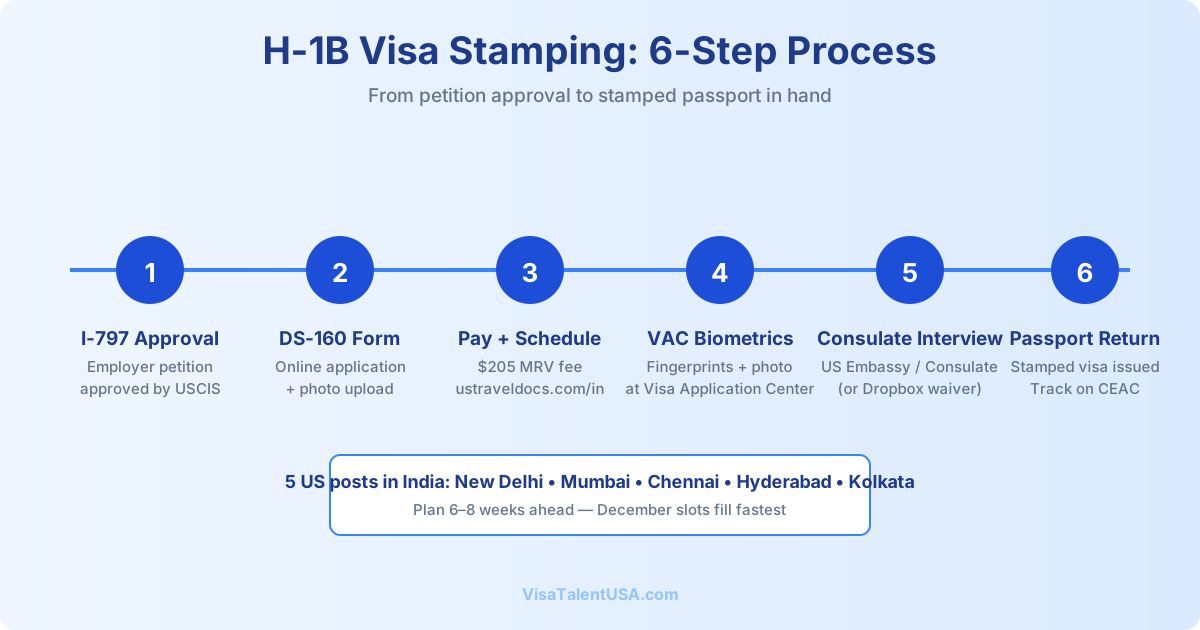
H-1B Visa Stamping: Key Facts (2026)
- What it is: The visa foil placed in your passport at a U.S. embassy/consulate — required to re-enter the U.S. (your I-797 approval alone is not enough)
- Where: 5 U.S. posts in India — New Delhi, Mumbai, Chennai, Hyderabad, Kolkata
- MRV fee: $205 (non-refundable, non-transferable)
- Interview waiver: Available for renewals under narrowed 2026 rules (same classification, prior stamp expired within 48 months)
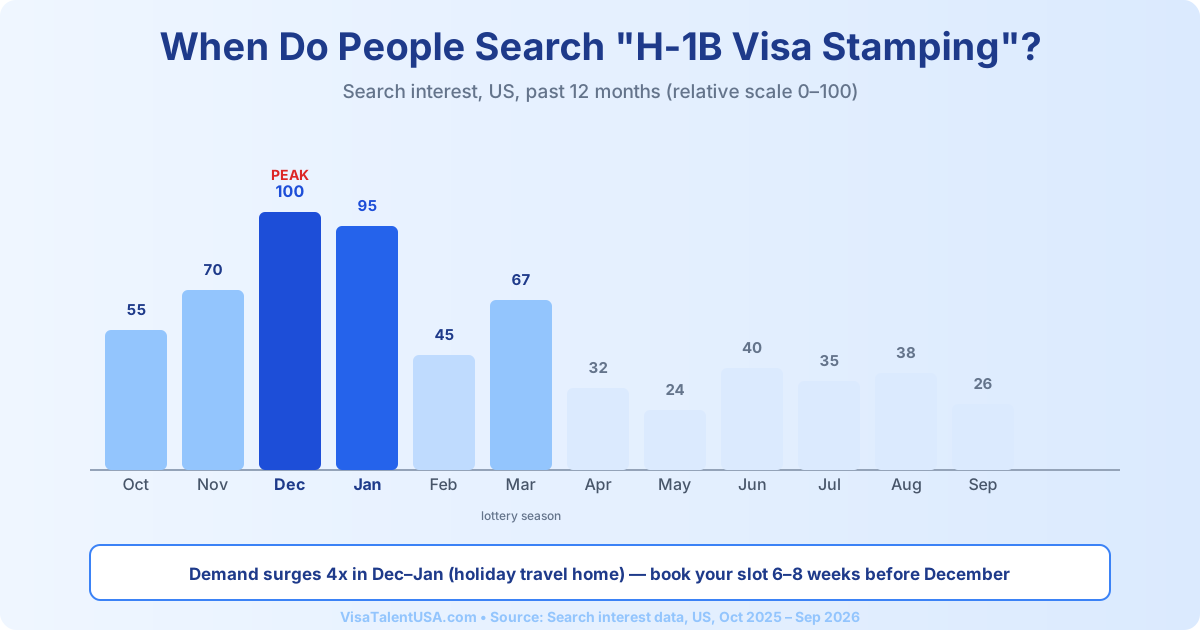
- Peak season: December–January demand surges ~4x — book 6–8 weeks ahead
- New in 2026: Expanded social-media vetting (set profiles to public), 1-reschedule limit on appointments
What Is H-1B Visa Stamping?
H-1B visa stamping is the process of getting the physical H-1B visa foil (the "stamp") placed in your passport at a U.S. embassy or consulate abroad. It is the document that lets an airline board you and lets a CBP officer admit you back into the United States in H-1B status.
This is the single most misunderstood concept in the H-1B world: your approved petition (Form I-797) is not a visa. The I-797 proves USCIS approved your employer's petition to employ you. The visa stamp proves a consular officer reviewed you and authorized travel to a U.S. port of entry. You need both. If you are already inside the U.S. in valid H-1B status and never leave, you may never need a stamp — but the moment you travel abroad, you cannot come back without one.
You cannot get an H-1B stamp inside the United States in almost all cases (the limited domestic revalidation pilot below is the narrow exception). That means every international trip — a holiday visit home, a wedding, a family emergency — requires planning around a consulate appointment in your home country or a third country.
The Complete H-1B Visa Stamping Process: 6 Steps
Here is exactly how H-1B visa stamping works for an applicant in India, from petition approval to passport in hand:
Step 1: Get Your I-797 Approval Notice
Your employer must first have an approved H-1B petition. You will need the original Form I-797 approval notice for your consulate interview — this is the single most important document in your file. If this is a transfer or extension, bring prior I-797s too, so the officer can see your continuous history.
Step 2: Complete the DS-160 Form
Fill out the DS-160 online nonimmigrant visa application at the State Department's Consular Electronic Application Center (CEAC). Be precise: your job title, employer name, and worksite must match your LCA and I-797 exactly. Upload a compliant visa photo. Save the DS-160 confirmation page with its barcode — you will need the confirmation number when scheduling.
Step 3: Pay the $205 MRV Fee and Schedule
Pay the Machine Readable Visa (MRV) application fee of $205 through the scheduling portal at ustraveldocs.com/in. The fee is non-refundable and non-transferable — if your plans change, you lose it. After payment, schedule two appointments: one at a Visa Application Center (VAC) for biometrics, and one at the embassy/consulate for the interview (unless you qualify for the interview waiver below).
Step 4: VAC Biometrics Appointment
Visit the Visa Application Center for fingerprints and a digital photo. Bring your passport, DS-160 confirmation, and appointment letter. This is quick — typically under 30 minutes — and usually scheduled a day or two before the consulate interview.
Step 5: Consulate Interview (or Dropbox)
Attend your interview at the U.S. embassy or consulate, or submit your documents through the Dropbox interview-waiver process if eligible. The officer will review your documents, ask questions about your job and employer, and decide on the spot in most straightforward cases.
Step 6: Passport Return and CEAC Tracking
If approved, your passport with the stamped visa is returned by courier in roughly 5–10 business days (longer in peak season). Track the status on CEAC (ceac.state.gov). Do not book non-refundable return travel until the passport is physically in your hands.
How to Find H-1B Visa Stamping Slots in India
This is the number-one anxiety for H-1B workers — Google searches for "h1b visa slots in india" surged 300% in the past year. The brutal truth: in peak season (November–January), interview slots at the five Indian posts can vanish within minutes of release. Here is a strategy that actually works:
- Book 6–8 weeks before December travel. Demand peaks in the week before Christmas. Slots released in October for December dates are the most contested of the year.
- Check all five posts. New Delhi, Mumbai, Chennai, Hyderabad, and Kolkata each release slots on their own schedule. If your home city is full, another post may have availability — you are permitted to apply at any post in India.
- Check early morning India time. New slot batches historically appear in the early morning hours. Set a routine: check the portal daily at the same early hour rather than randomly.
- Respect the 1-reschedule limit. Under current rules you may reschedule only once without penalty. Do not grab a slot "just in case" and plan to move it later — that safety net is gone.
- Use the expedited appointment request. For genuine emergencies (medical, family crisis, urgent business travel), the portal offers expedited appointment requests. Document your reason with evidence.
- Consider Dropbox first. If you are eligible for the interview waiver (see the self-test below), you skip the interview queue entirely — VAC document-drop slots are far easier to get.
H-1B Dropbox Eligibility Self-Test (2026 Rules)
The interview waiver — commonly called Dropbox — lets qualifying renewal applicants submit documents at a Visa Application Center without a consular interview. In 2026 the eligibility rules were narrowed, so test yourself honestly against all four conditions:
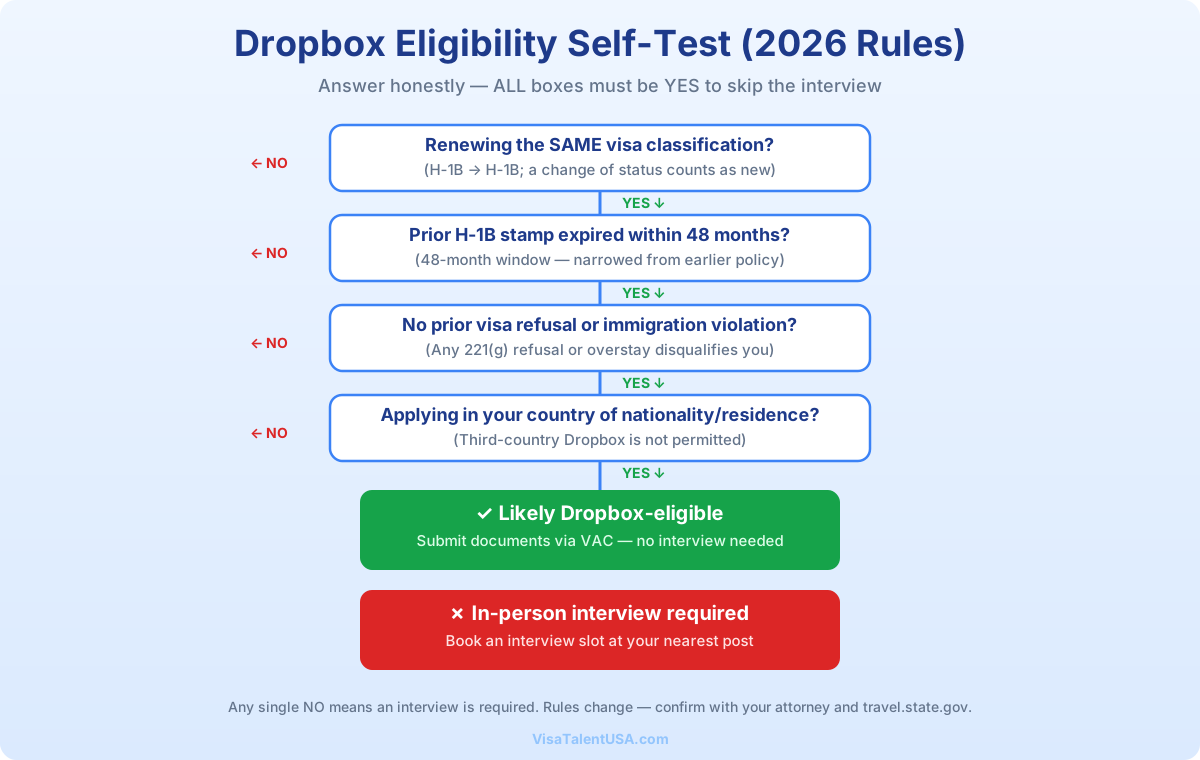
The 4 Dropbox Conditions (all must be YES)
- Same classification renewal: You are renewing an H-1B with another H-1B (not changing from F-1, L-1, etc.)
- 48-month window: Your prior H-1B visa expired no more than 48 months ago
- Clean record: No prior visa refusals and no immigration violations or overstays
- Home country: You are applying in your country of nationality or residence
A single NO means an in-person interview is required. Even if you pass all four, the consulate can still call you in for an interview — Dropbox is a waiver of the requirement, not a guarantee.
H-1B Visa Stamping Documents Checklist
Missing documents are the most common avoidable cause of delays and 221(g) holds. Assemble everything before your VAC appointment:
Required Documents
- Passport — valid at least 6 months beyond your intended U.S. stay, with blank pages
- Original Form I-797 approval notice — the current petition (bring prior I-797s for transfers/extensions)
- DS-160 confirmation page — with barcode
- Appointment confirmation — from ustraveldocs.com/in
- Certified LCA (Form ETA-9035) — the Labor Condition Application your employer filed with DOL
- Copy of Form I-129 petition — signed by your employer
- Employment verification letter — on company letterhead, confirming your job title, salary, and worksite
- Recent pay stubs — last 3 months if you are already employed in H-1B status
- Visa photo — compliant with State Department photo requirements
Helpful Supporting Documents
- Educational credentials and evaluation (if degree is foreign)
- Resume / CV matching the specialty occupation
- Prior U.S. tax returns (W-2s) if previously in H-1B status
- Marriage certificate (if spouse is applying for H-4)
Fee Table
| Fee | Amount | Notes |
|---|---|---|
| MRV application fee | $205 | Non-refundable, non-transferable; paid before scheduling |
| Visa issuance (reciprocity) fee | Varies | Depends on nationality; check the State Department reciprocity schedule |
| VAC / courier service | ~$20–30 | Passport delivery charges at the application center |
Note: your employer — not you — is legally required to pay H-1B petition costs (I-129, training fees). The $205 MRV stamping fee is the one cost workers typically pay themselves.
H-1B Stamping Interview Questions: What Officers Actually Ask
Consular interviews for H-1B are usually short (3–5 minutes) when the file is clean. The officer is verifying three things: the job is real, you are qualified for it, and your employer-employee relationship is genuine. Expect different emphasis depending on your situation:
First-Time Stamping
- What will your job title and duties be?
- Why does this role require your specific degree?
- How did you find this employer?
- What is your salary, and where will you work?
- Have you ever been to the U.S. before?
Renewal / Extension
- Are you still with the same employer in the same role?
- Has your salary or worksite changed?
- Can I see your recent pay stubs?
After an Employer Change (Transfer)
- Why did you change employers?
- What does your new employer do?
- Bring the new I-797 plus the old one — officers want the full chain.
Interview Tips
- Answer in your own words — memorized scripts sound rehearsed and raise flags
- Know your LCA details cold: job title, salary, worksite city
- Keep answers short and factual; volunteer documents, not stories
- Dress professionally and arrive 15 minutes early
221(g) Refusal & Administrative Processing: Recovery Playbook
A 221(g) refusal is not a denial — it means the officer needs more time or more documents before deciding. Your passport may be kept or returned; either way, the case goes into administrative processing. This is the highest-stakes scenario in H-1B stamping, and no competitor guide covers it properly.
Common 221(g) Triggers for H-1B
- Missing or mismatched documents (LCA vs. I-797 vs. DS-160 details)
- Employer verification — the officer wants to confirm the company and job are real
- Technology Alert List (TAL) review for sensitive technical fields
- Expanded background and social-media vetting (new in late 2025–2026)
- Prior travel or immigration history questions
What to Do If You Get a 221(g)
- Stay calm and get the slip. The officer will give you a colored slip listing exactly what is needed. Read it carefully before leaving the window.
- Submit exactly what is asked — nothing more, nothing less. Extra documents can slow things down. Respond through the channel the slip specifies (often email or VAC drop-off).
- Notify your employer and attorney immediately. If employer verification is the issue, your company's immigration team needs to respond fast.
- Protect your job. Tell your manager/HR the realistic timeline (see below) and ask about remote-work options from India while you wait. Many employers accommodate this; silence is what gets people in trouble.
- Track on CEAC. Your case status will show "Administrative Processing" until a decision. Do not bombard the consulate with inquiries in the first 60 days — it does not help.
Realistic Timelines
- Document-based 221(g): often resolved in 1–3 weeks after you submit
- Background/security checks: 60 days is common; complex cases can run several months
- TAL reviews: among the longest — plan for the worst case with your employer
H-1B Stamping Timeline Planner: Work Backwards
Never plan stamping forward from today. Plan backwards from your return flight to the U.S.:
| Stage | Typical Duration | Plan For |
|---|---|---|
| DS-160 + document gathering | 3–7 days | Start before you fly to India |
| MRV payment + slot booking | 1 day – 3 weeks | Peak season: 3+ weeks of checking |
| VAC biometrics | 1 day | Usually 1–2 days before interview |
| Consulate interview | 1 day | Half day with travel/waiting |
| Passport return | 5–10 business days | Peak season: up to 3 weeks |
| Buffer for 221(g) | 0 – 60+ days | Keep 2–4 flexible weeks if possible |
Golden rule: arrive in India at least 4–6 weeks before your U.S. return date in normal season, 8+ weeks if traveling in December–January. Never book a non-refundable return flight until the stamped passport is in your hands.
4 Scenarios: Which Track Are You On?
(a) First-Time Stamping in India
You were never stamped before. You need the full interview — no Dropbox. Book the earliest slot you can, prepare for the first-timer questions above, and bring extra evidence of your qualifications (degree, transcripts, evaluation). First-timers face the most scrutiny, so your documents must be flawless.
(b) Renewal via Dropbox
If you pass the 4-condition self-test, submit documents at a VAC and skip the interview. Dropbox processing is typically faster than the interview queue. But remember: the consulate can still summon you for an interview, so do not make unchangeable travel plans until issuance.
(c) Stamping in Canada or Mexico (Third-Country Nationals)
The State Department directs applicants to their country of nationality or residence, and third-country applications are discouraged — but they are not prohibited. Canada and Mexico posts accept TCN applicants with limited slots. Risks: if you get a 221(g) abroad, you are stuck outside both the U.S. and India. Only consider this if India slots are truly unavailable and your case is straightforward (renewal, clean history).
(d) Domestic Revalidation Pilot (Stamping Inside the U.S.)
The State Department ran a limited pilot allowing certain H-1B holders to renew their visas without leaving the United States. Eligibility was narrow (prior H-1B stamp, no refusals, specific issuance windows). The pilot's status and any expansion should be confirmed on travel.state.gov before you rely on it — as of this guide's last update, most applicants should still plan on stamping abroad.
2026 Policy Changes You Must Know
- Expanded social-media vetting: H-1B applicants are instructed to set social media accounts to public to facilitate identity and admissibility screening. Review your profiles before applying.
- Narrowed interview waivers: Dropbox eligibility was tightened — the 48-month prior-visa window and same-classification requirements are now strictly applied.
- 1-reschedule limit: You can reschedule your appointment only once without penalty. Choose your date carefully.
- Seasonal backlogs persist: December–January remains the crunch; spring sees a smaller bump tied to H-1B cap season news.
Policies change quickly. Always verify current rules on travel.state.gov, the U.S. Embassy in India, and with your immigration attorney before you travel.
H-1B Visa Stamping: Frequently Asked Questions
How long does H-1B visa stamping take in India?
From VAC biometrics to passport return, plan for 2–4 weeks in normal season. In December–January, allow 4–6 weeks. If you receive a 221(g), add 1–8+ weeks depending on the type of review. The slot-booking wait before you even start is separate — in peak season it can take weeks of daily checking to find an interview slot.
How do I find H-1B visa stamping slots in India?
Check the scheduling portal at ustraveldocs.com/in daily, early in the morning India time. Look across all five posts — New Delhi, Mumbai, Chennai, Hyderabad, and Kolkata — not just your home city. Book 6–8 weeks before December travel. If you qualify for Dropbox, VAC document-drop slots are far easier to secure than interview slots.
What is the H-1B stamping appointment wait time in India?
Wait times vary by post and season. Check the State Department's Global Visa Wait Times page for current estimates per post. December consistently shows the longest waits; April–May the shortest. These are estimates — your actual wait depends on when new slot batches are released.
Can I get H-1B stamping without an interview in 2026?
Possibly, through the Dropbox interview waiver — but the 2026 rules are narrower than before. You must be renewing the same classification (H-1B to H-1B), your prior H-1B visa must have expired within the last 48 months, you must have no prior refusals or violations, and you must apply in your home country. Use the self-test flowchart above.
What does a 221(g) mean for H-1B stamping?
A 221(g) is a temporary refusal pending further review — not a denial. Submit exactly what the officer's slip requests, notify your employer and attorney immediately, and track your case on CEAC. Document-based 221(g)s often resolve in 1–3 weeks; security or TAL reviews can take 60+ days. See the recovery playbook above.
Is it safe to travel to India for H-1B stamping now?
Stamping remains routine for straightforward cases, but 2026 brings tighter screening: expanded social-media vetting, narrowed interview waivers, and a 1-reschedule limit. Travel is "safe" if your documents are complete, your case is clean, and you build in buffer time. It is risky if you have prior refusals, a recent employer change with thin documentation, or a non-refundable return flight days after your interview.
How much does H-1B visa stamping cost?
The MRV application fee is $205 (non-refundable). A reciprocity issuance fee may apply depending on nationality. VAC/courier charges run about $20–30. Your employer pays the H-1B petition costs by law — the stamping fees are typically yours.
Can I do H-1B stamping in Canada or Mexico?
Third-country applications are discouraged but not prohibited, and Canada/Mexico posts accept a limited number of TCN applicants. Only consider this for straightforward renewal cases — if you hit a 221(g) abroad, you will be stuck outside both the U.S. and India while it resolves.
What if my H-1B stamp is delayed and I miss my return flight?
This is why the timeline planner above starts from your return date. If delayed: inform your employer/HR immediately with a realistic timeline, ask about remote work from India, change your flight (never book non-refundable until the passport is back), and track CEAC daily. Most employers have handled this before — proactive communication is everything.
Do I need H-1B stamping if I never leave the U.S.?
No. The visa stamp is only for re-entry. If you remain in the U.S. in valid H-1B status, your I-797 approval is sufficient. You need stamping only when you travel abroad and need to come back. (The limited domestic revalidation pilot is the narrow exception — confirm its current status on travel.state.gov.)
Methodology & Sources
This guide synthesizes current U.S. State Department guidance, U.S. Embassy in India notices, and observed consulate practice as of October 2026. Fee and procedural facts were verified against official sources; where practice varies by post or over time, we say so. Immigration policy changes frequently — verify critical details with your attorney before traveling.
Planning your H-1B journey? Explore our H-1B Sponsor Match tool to find employers that sponsor your job title, check your H-1B lottery odds, or browse the top 1,000 H-1B sponsors backed by 1.5M+ real Department of Labor filing records.
Sources
- U.S. Department of State — Bureau of Consular Affairs (travel.state.gov)
- U.S. Embassy & Consulates in India — Nonimmigrant Visas (in.usembassy.gov/visas)
- U.S. Department of State — Global Visa Wait Times
- U.S. Department of State — Visa Renewals / Interview Waiver guidance
- U.S. Citizenship and Immigration Services — H-1B Specialty Occupations
Last updated: October 13, 2026. Reviewed against current State Department guidance. Not legal advice — consult a qualified immigration attorney for your specific situation.