BREAKING — October 14, 2026: the Department of Homeland Security has formally proposed ending deference to prior H-1B approvals on extension petitions. If finalized, USCIS would stop giving weight to a previous approval when the same employer files an I-129 extension for the same worker — every renewal would face fresh scrutiny, more evidence requests, and longer waits. This step-by-step guide explains exactly what happened today, what "deference" has meant since 2004, what changes for your H-1B extension process, which employers' workforces face the most re-scrutiny, and what workers and employers should do right now.
Key facts (October 14, 2026)
- What: DHS proposed rule removing 8 CFR 214.1(c)(5) — the deference provision for I-129 extensions
- Docket: USCIS-2026-0529 — published in the Federal Register on October 14, 2026
- Status: PROPOSAL ONLY — current deference policy remains in effect until a final rule
- Comment deadline: ~November 13, 2026 (~30-day window)
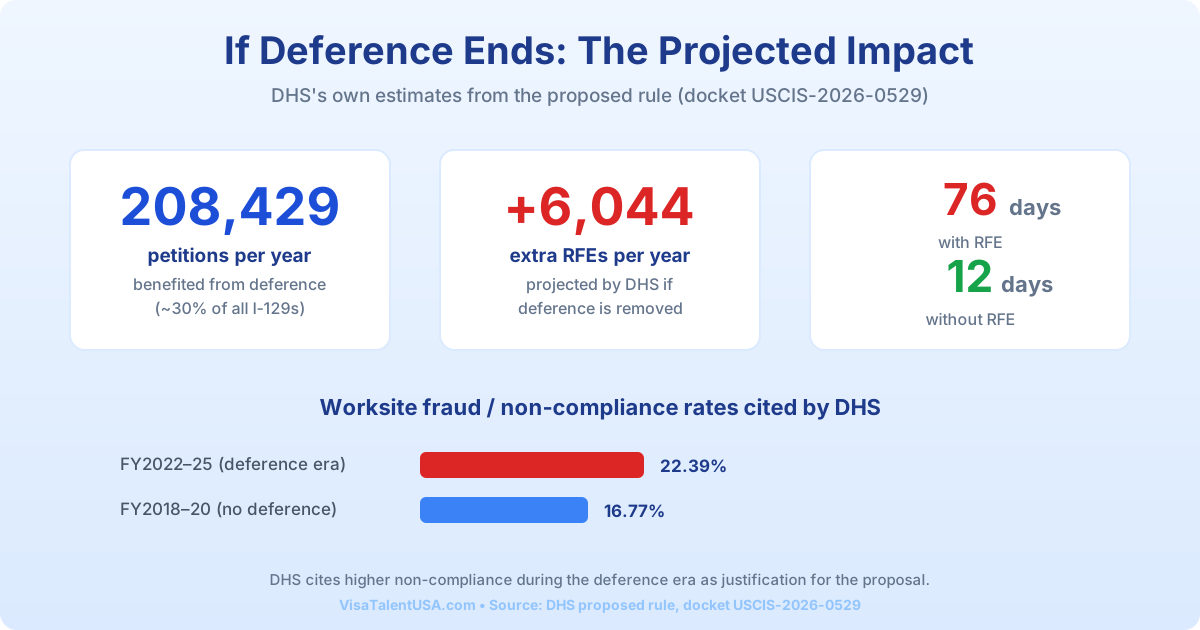
- DHS estimates: ~208,429 petitions/year benefited from deference; +6,044 RFEs/year projected; RFE cases average 76 days vs 12 days without
- Separate final rule (effective now): automatic H-4 EAD renewals ended — 20,000–33,000 EADs could lapse in an 18-month window starting May 2027
What Happened Today: The Proposed Rule in Plain English
On October 14, 2026, the Department of Homeland Security published a proposed rule in the Federal Register (docket USCIS-2026-0529) that would remove 8 CFR 214.1(c)(5) — the regulation that tells USCIS officers to generally defer to a prior approval when adjudicating an extension of stay involving the same parties and the same underlying facts.
In plain terms: today, when your employer files an H-1B extension and nothing material has changed — same job, same worksite, same qualifications — the USCIS officer is instructed to give weight to the fact that the case was already approved once. The proposal would erase that instruction. Every extension would be adjudicated as if the prior approval barely counts.
This is a proposal, not a final rule. The current deference policy remains fully in effect. DHS is required to accept public comments for roughly 30 days (deadline around November 13, 2026), review them, and then decide whether to issue a final rule — which could take months and could look different from the proposal. Do not change your extension strategy today based on a rule that does not yet exist.
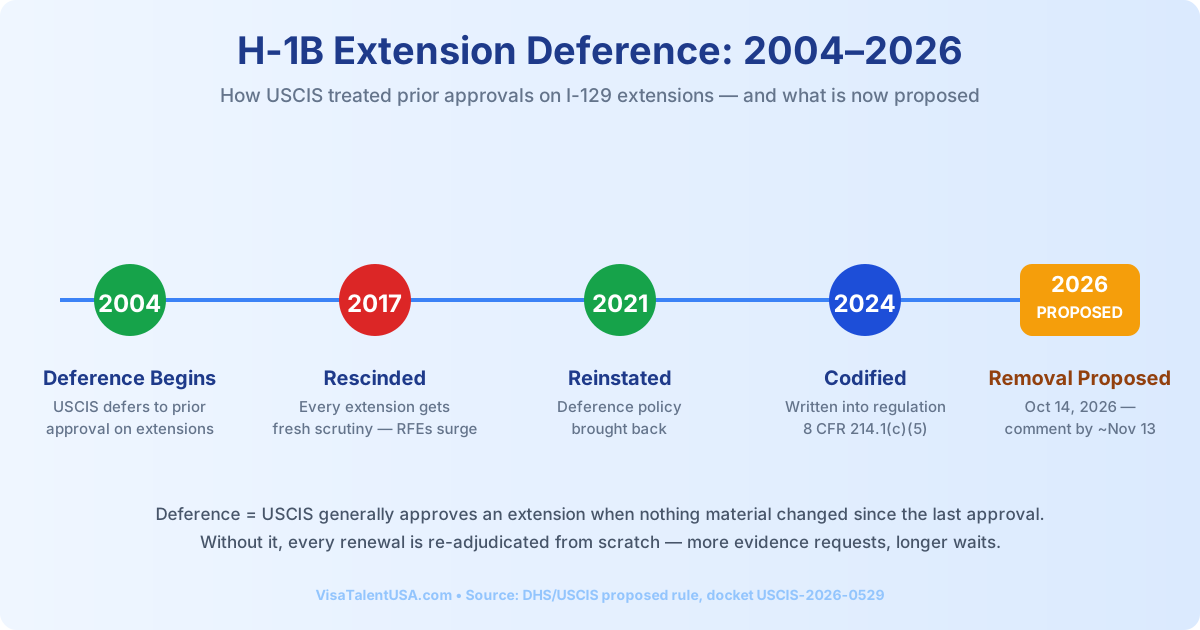
What "Deference" Has Meant: A 22-Year History
To understand why this matters, you need the history. USCIS deference policy has swung back and forth for two decades:
2004: Deference begins
USCIS issued guidance instructing officers to defer to prior determinations of eligibility when adjudicating extensions involving the same parties and facts. The logic was efficiency and consistency: if an officer already decided a worker qualifies for a specialty occupation at a given worksite, re-litigating that from zero on every three-year renewal wastes everyone's time.
2017: Deference rescinded
USCIS rescinded the deference memo. Officers were told to apply the same level of scrutiny to extension petitions as to initial petitions. The result was widely reported at the time: a surge in Requests for Evidence (RFEs) on routine extensions, including cases where nothing had changed since the prior approval.
2021: Deference reinstated
USCIS brought the deference policy back, again directing officers to give weight to prior approvals on extensions with unchanged facts.
December 2024: Deference codified
The policy was written into regulation as 8 CFR 214.1(c)(5) — moving it from agency guidance to binding rule.
October 2026: Removal proposed (today)
DHS now proposes to remove that exact regulation. If finalized, the policy would return to something like the 2017–2021 posture: no special weight for prior approvals.
DHS's stated justification, per the proposal: worksite fraud and non-compliance rates were higher during the deference era — 22.39% in FY2022–25 versus 16.77% in FY2018–20, according to DHS's own figures. Critics will note that correlation is not causation, and the comment period is the venue for that debate.
What Changes If This Is Finalized: Step by Step
Here is what the H-1B extension process would look like without deference, based on DHS's own projections and the 2017–2021 precedent:
Step 1: Your extension is filed as usual
Your employer files Form I-129 to extend your H-1B status. The filing mechanics do not change — same form, same fees, same supporting documents.
Step 2: The officer re-adjudicates from scratch
Instead of giving weight to your prior approval, the officer evaluates eligibility fresh: is this still a specialty occupation? Does the wage still meet requirements? Is the employer-employee relationship still valid? Evidence that was "good enough" three years ago may be questioned again.
Step 3: Expect more Requests for Evidence
DHS projects approximately 6,044 additional RFEs per year if deference is removed. An RFE is not a denial — but it is a demand for more documentation (detailed job duties, organizational charts, contracts, wage evidence) with a tight response deadline.
Step 4: Timelines stretch
DHS's figures: cases with an RFE average 76 days of processing versus 12 days without one. Even if your extension is ultimately approved, an RFE can add two-plus months of uncertainty — during which international travel is risky and job changes are complicated.
Step 5: Employers must build thicker files
The practical consequence: employers and attorneys will need to prepare extension filings as thoroughly as initial petitions — complete documentation packages, even when nothing changed. Expect higher legal costs and longer preparation lead times.
Scale of the change: DHS estimates about 208,429 petitions per year (roughly 30% of all I-129 filings in FY2022–25) benefited from deference. That is the population whose extensions would face the new, harder standard.
Separate Final Rule: H-4 EAD Automatic Renewals Have Ended
Buried alongside the proposal is a separate final rule that is effective immediately: automatic extensions of H-4 employment authorization documents (EADs) have ended.
Previously, certain H-4 spouses with timely-filed EAD renewal applications received an automatic extension of their work authorization while USCIS processed the renewal. That automatic extension is now gone. DHS estimates 20,000 to 33,000 EADs could lapse in an 18-month window starting May 2027 as workers hit gaps between their old EAD expiring and the renewal being approved.
If you are an H-4 EAD holder: file renewals as early as permitted, do not assume any grace period from an automatic extension, and talk to your employer about contingency planning for a potential work gap. Unlike the deference proposal, this change is final and in effect now.
Who Gets Hit Hardest: The Data
Which employers' workforces face the most re-scrutiny if every renewal is re-adjudicated? The answer tracks filing volume: employers with the largest H-1B populations have the most extensions cycling through the system. Below are the top 20 H-1B sponsors by FY2026 Labor Condition Application filing volume — real U.S. Department of Labor disclosure data.
Important honesty note: LCA records do not distinguish new petitions from extensions, so these are total filing volumes, not extension counts. But an employer's extension flow is roughly proportional to its overall H-1B footprint — the sponsors below are where the most renewals will face fresh scrutiny.
| # | Employer | FY2026 LCA filings | LCA certification rate | Median salary |
|---|---|---|---|---|
| 1 | Amazon | 19,937 | 99.9% | $158,000 |
| 2 | 7,389 | 99.4% | $193,000 | |
| 3 | Cognizant | 5,799 | 99.9% | $111,030 |
| 4 | Apple | 5,633 | 85.7% | $171,600 |
| 5 | EY (Ernst & Young) | 5,403 | 94.1% | $155,468 |
| 6 | Meta | 5,151 | 100.0% | $214,032 |
| 7 | Microsoft | 5,107 | 100.0% | $177,000 |
| 8 | Infosys | 4,610 | 99.5% | $92,581 |
| 9 | Deloitte | 4,230 | 99.4% | $129,900 |
| 10 | Tata Consultancy Services | 2,923 | 98.6% | $92,394 |
| 11 | Tesla | 2,896 | 89.0% | $150,000 |
| 12 | JPMorgan Chase | 2,751 | 99.7% | $160,000 |
| 13 | Nvidia | 2,457 | 96.9% | $186,472 |
| 14 | Fidelity Investments | 2,448 | 98.2% | $128,914 |
| 15 | Walmart | 2,313 | 93.6% | $145,704 |
| 16 | Goldman Sachs | 2,024 | 99.6% | $130,000 |
| 17 | Grandison Management | 1,987 | 99.0% | $73,715 |
| 18 | Compunnel Software Group | 1,941 | 99.9% | $113,000 |
| 19 | Wipro | 1,906 | 81.9% | $106,998 |
| 20 | Intel | 1,751 | 99.9% | $133,432 |
Source: U.S. Department of Labor LCA disclosure data, FY2026, via VisaTalentUSA. Figures are total LCA filings (new + extensions + amendments combined — the data does not break these out). Explore any employer in detail on our top H-1B sponsors list.
Two patterns stand out. First, the IT services firms (Cognizant, Infosys, TCS, Wipro) run high-volume, lower-median-salary H-1B programs — exactly the profile that drew extra scrutiny during the 2017–2021 no-deference period. Second, several large sponsors already show below-average LCA certification rates (Apple 85.7%, Tesla 89.0%, Wipro 81.9%, Walmart 93.6%) — workers at these employers should be especially prepared for a tougher extension environment.
Want to check your own employer's H-1B profile? Use our sponsor match tool to look up any company by name.
What To Do Right Now: Action Checklist
If you are an H-1B worker with an extension coming up
- Do not panic — nothing has changed yet. Deference is still the law today. But start preparing as if it might not be.
- File early. USCIS allows extensions up to 6 months before status expires. Early filing buys buffer against RFE delays.
- Ask your attorney for an "RFE-proof" file: updated job description, org chart, proof of specialty-occupation duties, wage evidence — the full package, not the slim renewal version.
- Avoid international travel while an extension is pending if you can — re-entry complications multiply when adjudication is uncertain.
- Keep every prior approval notice (I-797), pay stubs, and employment verification letters organized and accessible.
If you are an employer or HR/immigration team
- Audit your upcoming renewal pipeline: how many extensions in the next 12 months, and which roles are hardest to document?
- Budget for higher legal costs — thicker filings mean more attorney hours per extension.
- Consider filing a comment on docket USCIS-2026-0529 before ~November 13, 2026 — especially if you can quantify business impact.
- Brief hiring managers that start dates for extensions may slip if RFEs rise.
If you are an H-4 EAD holder (urgent — this one is final)
- File your EAD renewal at the earliest allowed date. There is no more automatic extension bridging the gap.
- Talk to your employer now about what happens if your EAD lapses — some employers can place you on unpaid leave; some cannot.
- Track the May 2027 window: DHS projects 20,000–33,000 EADs lapsing in the 18 months from May 2027. If your renewal falls in that window, plan ahead.
Timeline: What Happens Next
Rulemaking follows a fixed sequence. Here is the realistic calendar for the deference proposal:
- October 14, 2026 (today): proposed rule published in the Federal Register; comment period opens.
- ~November 13, 2026: comment period closes. DHS must read and respond to substantive comments.
- Late 2026 – 2027: DHS drafts a final rule. This routinely takes many months; controversial rules can take over a year.
- Final rule published: includes an effective date, usually 30–60 days after publication. Only then does deference actually end.
- Possible litigation: major immigration rules are frequently challenged in federal court, which can delay or block implementation.
Bottom line: the earliest this could realistically take effect is well into 2027, and it could be delayed or altered. But the direction of travel is clear — prepare accordingly.
H-1B Extension Process: Frequently Asked Questions
Has USCIS already ended deference on H-1B extensions?
No. As of October 14, 2026, DHS has only proposed removing the deference regulation. The current policy — officers generally defer to prior approvals on extensions with unchanged facts — remains in effect until a final rule is published.
How does the H-1B extension process work right now?
Your employer files Form I-129 before your current status expires (up to 6 months early). Under the current deference policy, if nothing material changed — same job, same worksite, same qualifications — the officer gives weight to your prior approval. Processing is typically faster and RFEs less likely than for initial petitions.
What is an RFE and why does it matter here?
A Request for Evidence is USCIS asking for more documentation before deciding your case. DHS projects ~6,044 additional RFEs per year if deference ends, and RFE cases average 76 days versus 12 days without one. An RFE is not a denial, but it adds months of uncertainty.
When is the comment deadline for the proposed rule?
Approximately November 13, 2026 — about 30 days from the October 14 Federal Register publication (docket USCIS-2026-0529). Anyone can submit a comment, and DHS must consider substantive ones before finalizing.
Does this affect my pending or already-filed extension?
No. The proposal, even if finalized, would apply prospectively from its effective date. Extensions filed and adjudicated under the current rule are governed by the current rule.
What happened to H-4 EAD automatic renewals?
They have ended under a separate final rule that is effective now. H-4 spouses must have a valid, unexpired EAD to work — there is no longer an automatic extension while a renewal is pending. DHS estimates 20,000–33,000 EADs could lapse in an 18-month window starting May 2027.
Which employers will feel this most?
Employers with the largest H-1B workforces will see the most extensions re-scrutinized — led by Amazon (~19,900 FY2026 LCA filings), Google, Cognizant, Apple, and EY. IT services firms with high-volume programs faced the heaviest scrutiny during the last no-deference period (2017–2021).
Should I file my extension earlier than planned?
Filing up to 6 months before expiry is already allowed and is prudent regardless — it builds buffer against any processing slowdown. Talk to your immigration attorney about timing; do not file a weaker, rushed petition just to beat a rule that is not yet final.
Methodology & Sources
This article is based on the DHS proposed rule published in the Federal Register on October 14, 2026 (docket USCIS-2026-0529), including DHS's own statistical estimates cited in the proposal. Employer filing data is from U.S. Department of Labor Labor Condition Application disclosure files for FY2026, which record total LCA filings and do not distinguish new petitions from extensions — employer rankings reflect total filing volume. Policy history (2004–2024) reflects published USCIS guidance and rulemaking. Immigration policy changes frequently — verify critical details with your attorney before acting.
Sources
- U.S. Department of Homeland Security — Proposed rule, docket USCIS-2026-0529, Federal Register, October 14, 2026
- U.S. Citizenship and Immigration Services — I-129 petition guidance (uscis.gov)
- U.S. Department of Labor — LCA disclosure data, FY2026 (flag.dol.gov)
Published: October 14, 2026. This is a developing story — we will update this guide as the rulemaking progresses. Not legal advice — consult a qualified immigration attorney for your specific situation.