 By Muhammad Talha
The $100,000 H-1B fee is not being collected today. Two federal courts have blocked the agencies from enforcing it, the government has appealed to the Ninth Circuit and asked that court to pause one of the blocking orders, and a separate DHS proposal for a $103,265 fee is still only a proposal. This page tracks the live status, the full court timeline, and the one fee proposal that is easy to confuse with it — with every date tied to its proclamation, court order, or Federal Register document.
STATUS — BLOCKED (as of October 25, 2026)
The $100,000 payment is not being collected. A Massachusetts court vacated the implementing policies on June 8, 2026, and a California court blocked enforcement under both the original proclamation and its 2026 extension on September 30, 2026. The government's October 9, 2026 appeal to the Ninth Circuit does not lift either order — only a stay granted by an appeals court would. USCIS says it will comply with the orders for now, but still intends to collect the payment if an order is lifted.
Key facts — the $100,000 H-1B fee at a glance
- What it is: a $100,000 payment on certain new H-1B petitions, created by Presidential Proclamation 10973 (September 19, 2025), effective September 21, 2025.
- Who it targeted: mainly new petitions for beneficiaries outside the United States without a valid H-1B visa, plus consular-notification cases — per USCIS guidance of October 20, 2025.
- Actually paid: the payment was made for over 700 petitions while it was in force, according to the extension proclamation itself.
- Still on paper: Proclamation 11069 (September 18, 2026) extended the restriction through September 21, 2027 — but enforcement is blocked, so the extension currently has no practical effect.
- The other fee: DHS proposed a separate $103,265 fee on cap-subject petitions on August 25, 2026. It isnot in effect; comments closed September 24, 2026, and no final rule has been issued.
- What changes the status: a stay granted by the First, Ninth, or D.C. Circuit; a merits win for the government; or a final $103,265 rule.
What the $100,000 fee actually was
Presidential Proclamation 10973, titled “Restriction on Entry of Certain Nonimmigrant Workers,” restricted the entry of H-1B specialty-occupation workers unless their petition was accompanied or supplemented by a $100,000 payment from the employer. It directed the Department of Homeland Security to restrict decisions on petitions for workers outside the United States that lacked the payment, and the Department of State to verify payment during visa processing.
Three clarifications mattered from the start. First, the payment was one-time per petition, not annual. Second, it applied only prospectively — petitions filed before September 21, 2025, approved petitions, and holders of valid H-1B visas were never covered, and current holders could keep traveling freely. Third, the Secretary of Homeland Security could grant national-interest exceptions for individual workers, companies, or industries — a route USCIS described as extraordinarily rare.
For scale: before this proclamation, ordinary H-1B filing fees topped out at roughly $7,595 per petition depending on the employer and the case. The $100,000 payment was more than thirteen times that ceiling, which is exactly why it ended up in court within months.
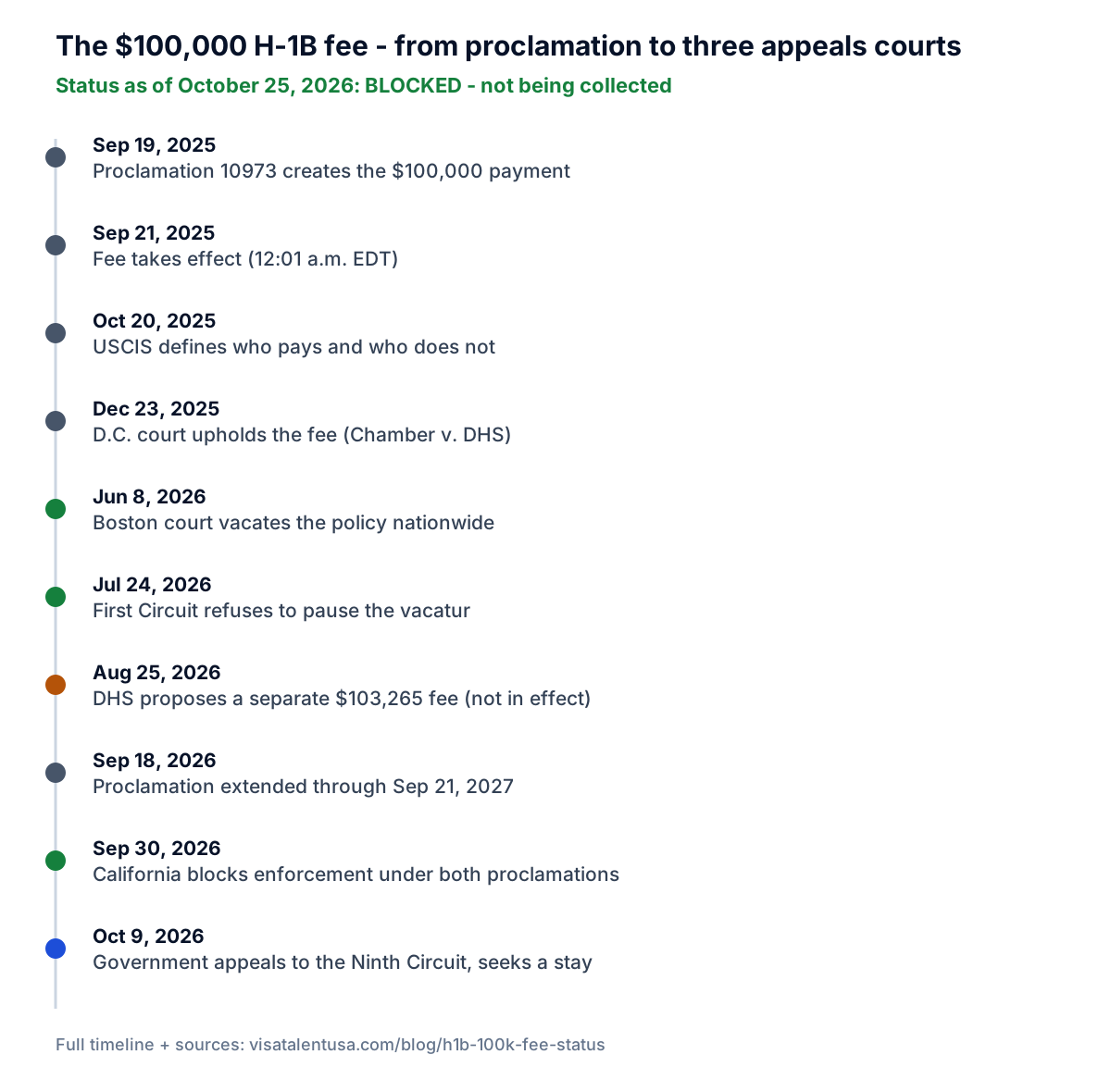
Full timeline: from proclamation to three appeals courts
Every event below names the document or court behind it. Where a court order and press coverage disagree on a date, the court's own date is used — the California order, for example, is dated September 30, 2026 in the United States, even though it was reported on October 1 in South Asian press.
| Date | Event | What it meant |
|---|---|---|
| Sep 19, 2025 | Presidential Proclamation 10973 signed | $100,000 payment created for certain new H-1B petitions, citing presidential entry-restriction power (INA §§ 212(f) and 215(a)). |
| Sep 20, 2025 | White House, USCIS, and CBP clarify scope | Prospective only: earlier petitions, approved petitions, and valid visa holders are not covered. |
| Sep 21, 2025 | Proclamation takes effect (12:01 a.m. EDT) | Collection begins for covered petitions; payment via Pay.gov, proof filed with the petition. |
| Oct 20, 2025 | USCIS publishes detailed applicability guidance | Defines exactly who pays and who does not (see the tables below); adds the guidance to the fee schedule and payment website. |
| Dec 23, 2025 | D.C. court upholds the fee — Chamber of Commerce v. DHS, No. 1:25-cv-03675, Judge Beryl Howell | First ruling goes the government's way: the proclamation falls within § 212(f) authority. Appealed December 29, 2025; argued before the D.C. Circuit in March 2026; still undecided. |
| Jun 8, 2026 | Massachusetts court vacates the policy — 20-state case, No. 1:25-cv-13829, Judge Leo T. Sorokin | The payment is, in substance, a tax Congress never authorized, and the rollout violated the Administrative Procedure Act. The implementing policies are vacated in their entirety, nationwide, with immediate effect. |
| Jun–Jul 2026 | Brief administrative stay | The district court briefly pauses its own order so the government can seek emergency relief; USCIS collects the fee again in that short window. |
| Jul 24, 2026 | First Circuit denies a stay — No. 26-1699 | A three-judge panel finds the government has not shown a strong likelihood of winning. The June 8 vacatur is back in force. The merits appeal continues. |
| Aug 25, 2026 | DHS proposes a separate $103,265 fee | Notice of proposed rulemaking in the Federal Register (Docket USCIS-2026-0298) for cap-subject petitions only. Comments closed September 24, 2026. Not in effect. |
| Sep 18, 2026 | Proclamation 11069 extends the restriction | The 2025 restriction is extended through September 21, 2027, on unchanged terms. The proclamation notes the payment had been made for over 700 petitions. |
| Sep 30, 2026 | California court blocks enforcement — Global Nurse Force v. Trump, No. 4:25-cv-08454, Judge Haywood S. Gilliam Jr. | Preliminary injunction: agencies may not enforce the fee policies under either proclamation until they complete notice-and-comment rulemaking. The proclamations themselves are left standing. |
| Oct 9, 2026 | Government appeals to the Ninth Circuit and seeks a stay | The appeal alone lifts nothing — only a granted stay would. No stay had been reported as of October 25, 2026. The fee is now before three appeals courts at once. |
Who would pay if the blocks were lifted
The tables below are the scope USCIS itself set on October 20, 2025. They describe what would apply if a court lifts the blocks — they are not in force today, because the Massachusetts court vacated the USCIS memo and FAQ and the California court enjoined the agency policies. If collection ever resumes, expect USCIS to reissue guidance before anyone is asked to pay.
Would have to pay (when the fee was in force)
| New H-1B petitions filed on or after September 21, 2025 for beneficiaries outside the United States who do not hold a valid H-1B visa. |
| Petitions requesting consular notification, port-of-entry notification, or pre-flight inspection — even if the beneficiary was inside the United States when filed. |
| Change-of-status, amendment, or extension petitions where USCIS denies the requested benefit and instead approves the case for consular processing. |
Would not have to pay
| Any H-1B petition filed before September 21, 2025. |
| Approved change of status, amendment, extension, or change of employer for someone inside the United States — including the usual F-1 (OPT) to H-1B change of status. |
| Holders of valid H-1B visas traveling in and out of the United States. |
| Nobody was exempted because of cap-exempt status: the payment never turned on whether the employer was cap-exempt or cap-subject. See our Cap-Exempt Employers Finder for how cap-exempt sponsorship actually works. |
When the fee was in force, the employer had to pay through the Treasury's Pay.gov portal before filing and include proof of payment with the petition — a petition without it was denied. National-interest exceptions existed on paper but were described by USCIS as extraordinarily rare.
Two fees — do not mix them up
The single biggest source of confusion in this story is that two different six-figure H-1B fees now exist in public discussion. They are separate, with different legal bases, different targets, and different fates.
| $100,000 proclamation payment | $103,265 DHS proposal | |
|---|---|---|
| Origin | Presidential Proclamation 10973 (Sep 19, 2025), extended by Proclamation 11069 (Sep 18, 2026) | DHS notice of proposed rulemaking, Federal Register, Aug 25, 2026 (Docket USCIS-2026-0298) |
| Legal basis claimed | Presidential power to restrict entry, INA §§ 212(f) and 215(a) | DHS statutory fee-setting and cost-recovery authority |
| Applies to | Certain new H-1B petitions, mainly for workers abroad | Cap-subject H-1B petitions only (the 65,000 regular cap plus the 20,000 U.S. master's exemption) |
| Cap-exempt employers | Never the deciding factor | Explicitly excluded — universities and nonprofit research organizations would pay nothing under it |
| Status today | On paper through Sep 21, 2027, but enforcement blocked by two court orders | Proposal only; comment period closed Sep 24, 2026; no final rule, no effective date |
| What would activate it | A court stay or a merits win lifting the blocks | A final rule — which would then face its own legal challenges |
DHS itself acknowledges in the proposed rule that $103,265 is close to the $100,000 proclamation payment, but distinguishes it on legal grounds: the proposal rests on fee-setting authority, not proclamation power. That distinction is the whole point of the rulemaking — it is designed to survive the procedural objections that blocked the proclamation in two of the three court cases. And note: the proposal is in addition to existing filing fees, not a replacement for them. If both fees ever applied at once, they would stack.
Why three courts gave three different answers
Washington, D.C. — upheld (December 2025). Judge Beryl Howell, in a case brought by the U.S. Chamber of Commerce and the Association of American Universities, held the proclamation fell within the President's § 212(f) authority to restrict entry. That decision is on appeal; the D.C. Circuit heard argument in March 2026 and has not decided.
Massachusetts — vacated (June 2026). Judge Sorokin, in the 20-state case, went to the substance: whatever it is called, a $100,000 payment that functions as a tax needs Congress, and Congress never authorized it. He also found the rollout violated the Administrative Procedure Act. His order vacated the implementing policies entirely and applies nationwide.
California — enjoined (September 2026). Judge Gilliam did not decide whether the President had authority at all. His ground was procedure: the agencies turned the proclamation into working rules through memos, FAQs, and a payment website without the notice-and-comment rulemaking the APA requires. His preliminary injunction therefore blocks the agency policies — under both proclamations — while leaving the proclamations themselves standing.
The practical result is a split that only higher courts can resolve: one district court upheld the fee, two blocked its enforcement on different grounds, and three appeals courts are now involved at once. The government's own stay request says the dispute will likely reach the Supreme Court. Until a stay or a merits decision changes something, the two blocking orders control — which is why the status box at the top of this page says BLOCKED, not “cancelled.” The fee is blocked, not repealed.
What to watch next
- Ninth Circuit stay decision on the September 30 California order — requested October 9, 2026, with no stay reported as of October 25, 2026. A granted stay is the fastest way collection resumes, faster than any final ruling.
- First Circuit merits appeal of the June 8 Massachusetts vacatur — merits briefing concluded October 16, 2026, according to law-firm reporting; a decision is pending.
- D.C. Circuit appeal of the December 2025 ruling upholding the fee — argued March 2026, undecided. A government win there deepens the split.
- Northern District of California case management conference on October 27, 2026 — procedural; unlikely to change the status by itself, but it sets the schedule for the underlying case.
- $103,265 final rule — comments closed September 24, 2026; no final rule and no effective date have been announced.
This page is re-checked daily against court dockets and USCIS guidance. The status box at the top changes the day any of the above moves — not at the next news cycle.
What employers should do now
- Do not pay the $100,000 today. It is not being collected. Ordinary USCIS filing fees still apply in full.
- Do not budget it as zero forever. Treat it as a contingent cost: USCIS has said DHS still intends to collect the payment if the blocking orders are lifted.
- Confirm with immigration counsel before filing any petition that would have been covered — especially workers abroad and consular-processing cases.
- Watch stay motions, not just final rulings. A stay can restore collection in days, while a merits appeal takes months.
- Keep the $103,265 proposal in a separate budget line. It is a different fee, on a different legal track, with a different fate — and it would stack on top of existing fees if finalized.
- If you already paid: over 700 petitions did while the fee was in force. No refund process for those payments has appeared in the sources we checked — ask counsel before assuming anything about recovery.
Frequently asked questions
Is the $100,000 H-1B fee active now?
No. As of October 25, 2026, two federal court orders block its enforcement — the June 8, 2026 Massachusetts vacatur and the September 30, 2026 California injunction — and USCIS is not collecting the payment. The government's October 9, 2026 appeal to the Ninth Circuit does not change that, because an appeal alone does not lift an injunction.
Who would have to pay the $100,000 fee if it came back?
Under the USCIS guidance of October 20, 2025: employers filing new H-1B petitions for beneficiaries outside the United States without a valid H-1B visa; petitions requesting consular, port-of-entry, or pre-flight notification; and change-of-status, amendment, or extension petitions where USCIS denies the requested benefit and approves the case for consular processing instead.
Does the fee apply to renewals, extensions, or F-1 to H-1B change of status?
No — not under the USCIS guidance. Approved change of status, amendment, extension, or change of employer for someone inside the United States was outside the fee's scope, and that includes the usual F-1 (OPT) to H-1B change of status. The fee only attached if the requested benefit was denied and the case went to consular processing.
What is the $103,265 H-1B fee? Is it the same thing?
No. It is a separate DHS proposal published in the Federal Register on August 25, 2026 (Docket USCIS-2026-0298) that would charge $103,265 on every cap-subject H-1B petition, on top of existing fees. It is not in effect, its comment period closed September 24, 2026, and no final rule has been issued. It also explicitly excludes cap-exempt employers, which the proclamation payment never did.
Can the $100,000 fee come back?
Yes. If an appeals court grants a stay of either blocking order, or if the government wins on the merits, collection can resume — and USCIS has said DHS still intends to collect the payment if the orders are lifted. That is why this page says BLOCKED rather than cancelled, and why employers should keep it as a contingent cost.
Did the September 2026 extension bring the fee back?
No. Proclamation 11069 (September 18, 2026) extended the restriction on paper through September 21, 2027, but the September 30, 2026 California order expressly covers implementation under both the original proclamation and the extension. The extension changed the paper expiry date, not the enforcement reality.
How many employers actually paid the $100,000?
Over 700 petitions, according to Proclamation 11069 itself, which states the payment had been made for over 700 petitions since the original proclamation took effect on September 21, 2025. The proclamation also cites its own impact figures — including a fall in large IT outsourcing firms' combined H-1B registrations from 24,946 to 2,055 — as the administration's characterization of the policy's effect, not as independently verified data.
What should employers do right now?
Do not pay the $100,000 today, but do not treat it as gone either: keep it as a contingent cost, confirm any covered filing with immigration counsel, watch stay decisions (the fastest way it returns), and keep the separate $103,265 proposal in its own budget line.
Methodology & Sources
Every date in this article comes from a primary document or a court record: Presidential Proclamation 10973 (90 FR 46027) and Proclamation 11069 (91 FR 60497); the DHS notice of proposed rulemaking published August 25, 2026; USCIS guidance of October 20, 2025 and its compliance statement of July 28, 2026; and the dockets in the District of Massachusetts (No. 1:25-cv-13829), the Northern District of California (No. 4:25-cv-08454), the District of Columbia (No. 1:25-cv-03675), the First Circuit (No. 26-1699), and the Ninth Circuit (appeal filed October 9, 2026). Court reporting was cross-checked across multiple law-firm and news sources before any date was used. Administration impact figures are attributed to the proclamation that states them, not presented as independent verification. This article reports the status; it does not predict how any court will rule.
Sources
- Presidential Proclamation 10973, “Restriction on Entry of Certain Nonimmigrant Workers,” 90 FR 46027 (September 24, 2025) — the original $100,000 payment, effective September 21, 2025
- Presidential Proclamation 11069, 91 FR 60497 (September 23, 2026) — extension through September 21, 2027; states the payment had been made for over 700 petitions (govinfo.gov)
- DHS / USCIS notice of proposed rulemaking, Federal Register, August 25, 2026 — the separate $103,265 fee on cap-subject petitions, Docket USCIS-2026-0298 (govinfo.gov)
- USCIS — H-1B Specialty Occupations — current agency position, including the July 28, 2026 statement that DHS will comply with the court orders but still intends to collect the payment if they are lifted (uscis.gov)
- Court records: State of California v. Mullin, No. 1:25-cv-13829 (D. Mass., June 8, 2026 — vacatur); Global Nurse Force v. Trump, No. 4:25-cv-08454 (N.D. Cal., September 30, 2026 — preliminary injunction); Chamber of Commerce v. DHS, No. 1:25-cv-03675 (D.D.C., December 23, 2025 — fee upheld, on appeal); First Circuit No. 26-1699 (stay denied July 24, 2026); Ninth Circuit appeal filed October 9, 2026 (stay requested, none reported as of October 25, 2026)
- VisaTalentUSA — Cap-Exempt Employers Finder — the cap-exempt / cap-subject distinction and the fee FAQ
Published: October 25, 2026. Status last checked: October 25, 2026. This page is re-checked daily and updated the same day the status changes. Not legal advice — consult a qualified immigration attorney for your specific situation.