 By Muhammad Talha
If your H-1B job ends — layoff, termination, or resignation — you do not lose lawful status the next morning. Under 8 CFR 214.1(l)(2), you get a discretionary period of up to 60 consecutive calendar days, or until your authorized validity period (your I-94) ends, whichever is shorter, once per authorized validity period. During it you keep your status, but you cannot work — unless a separate authorization applies, such as H-1B portability when a new employer files a nonfrivolous I-129. And one urgent warning: DHS has proposed eliminating this grace period entirely (comments due November 10, 2026). That proposal is not law yet — the current rule still applies. This guide gives you the rule exactly as written, a day-by-day plan, and what to do about the proposal.
Key facts (last checked October 30, 2026)
- Rule: 8 CFR 214.1(l)(2) — up to 60 consecutive calendar days or until I-94 expiry, whichever is shorter, once per authorized validity period
- Discretionary, not guaranteed: DHS may shorten or eliminate it case by case; there is no form to apply for it — USCIS decides when adjudicating your later filing
- No work during the grace period unless a separate authorization applies — H-1B portability begins when USCIS receives a new nonfrivolous I-129, not on approval
- Clock start: the day after termination, typically the last day for which a salary or wage is paid — severance paid after your last working day does not automatically move it
- Who it covers: E-1, E-2, E-3, H-1B, H-1B1, L-1, O-1, and TN workers and their dependents
- 2026 proposal (NOT law): DHS proposes deleting 214.1(l)(2) — 91 FR 57807, September 11, 2026, docket USCIS-2026-0364, comments due November 10, 2026
- H-4 spouses: an H-4 EAD remains valid during the grace period, per USCIS — but not after it ends without a new basis
The Rule, Quoted and Explained
The regulation itself is short, and it is worth reading verbatim, because most of the confusion about the grace period comes from paraphrases that drop one of its limits:
"An alien admitted or otherwise provided status in E-1, E-2, E-3, H-1B, H-1B1, L-1, O-1 or TN classification and his or her dependents shall not be considered to have failed to maintain nonimmigrant status solely on the basis of a cessation of the employment on which the alien's classification was based, for up to 60 consecutive days or until the end of the authorized validity period, whichever is shorter, once during each authorized validity period. DHS may eliminate or shorten this 60-day period as a matter of discretion. Unless otherwise authorized under 8 CFR 274a.12, the alien may not work during such a period." — 8 CFR 214.1(l)(2)
In plain English, every clause of that paragraph is doing work:
| Element | What it means for you |
|---|---|
| Who is covered | Workers in E-1, E-2, E-3, H-1B, H-1B1, L-1, O-1, and TN status — and their dependents. It does not cover F-1/OPT, which has its own separate unemployment limits. |
| How long | Up to 60 consecutive calendar days. Weekends and holidays count. |
| The hard cap | Your I-94 / authorized validity end cuts the period short. If your I-94 has 20 days left, your window is 20 days, not 60. |
| How often | Once per authorized validity period. A new employer and a new validity period can give rise to a fresh grace period later; returning to the same employer on the same petition does not reset it. |
| Discretionary | DHS may shorten or eliminate it case by case. In practice most workers who maintained status receive it, but it is only confirmed when USCIS adjudicates your later filing — so ask for a favorable exercise of discretion in that filing's cover letter. |
| No work | Status during the grace period is not work authorization. Freelance, remote, or unpaid work in a normally paid role can count as unauthorized employment. |
| No form | There is no application for the grace period itself. It is determined when USCIS adjudicates your next petition or application. |
| Voluntary or involuntary | Both count. USCIS confirms the grace period may apply to voluntary and involuntary cessation alike — resignation counts the same way a layoff does. |
The rule dates to the January 2017 high-skilled workers regulation (81 FR 82398, effective January 17, 2017). Before 2016 there was no such grace period at all — which is exactly what the 2026 proposal would return to.
60-Day vs. 10-Day vs. 180-Day: Do Not Mix These Up
Three different numbers circulate for H-1B grace periods, and only two of them are real. Mixing them up is one of the most common — and most expensive — mistakes in this area.
| 60-day period — 8 CFR 214.1(l)(2) | 10-day period — 8 CFR 214.1(l)(1) / 214.2(h)(13)(i)(A) | |
|---|---|---|
| Trigger | Employment ends before the validity period ends (layoff, resignation, termination) | Validity period runs its full course (job completed, petition expires, no extension filed) |
| Length | Up to 60 consecutive days, capped by validity / I-94 end | Up to 10 days before validity begins and up to 10 days after it ends |
| Work? | No, except under a separate authorization | No, except during the validity period itself |
| Can you stack them? | No. The 10-day period may not be added to the 60-day period. If you are laid off mid-petition, the 60-day rule is the relevant one — not the 10-day rule. | |
And the 90-day, 120-day, and 180-day grace periods do not exist. Those figures come from old confusion and from an advisory-panel recommendation that was never implemented. The current regulation says 60. Anyone promising you 90 or 180 days is selling you a deadline that will not hold.
One more distinction that decides real cases: your visa stamp expiry is not your deadline — your I-94 is. The stamp is permission to seek entry; the I-94 records how long you are authorized to stay. Check your I-94 on the CBP I-94 website, not the stamp in your passport.
When Does the Clock Actually Start?
USCIS applies a simple test: the clock starts the day after termination of employment, typically determined by the last day for which a salary or wage is paid. The hard part is that "last day" is not always the day you cleaned out your desk. Use this table — and get the deciding date in writing from your employer:
| Situation | What happens to the clock | Document that proves it |
|---|---|---|
| Immediate termination, no severance | Clock starts the day after your last working day. | Termination letter with the last working day stated. |
| Lump-sum severance or PTO payout after your last working day | Does not automatically move the clock. Severance is generally compensation for job loss, not payment for services rendered. | Severance agreement showing the payment is post-employment compensation, plus your final pay stub. |
| Garden leave / formal notice period, still an active paid W-2 employee | Fact-dependent: if you remain an active, paid employee with the petition and LCA intact, cessation may be later — but this is scrutinized in 2026 adjudication. Do not assume it; get it confirmed. | Written confirmation that you remain employed, paid, and in the same role, with petition and LCA unwithdrawn. |
| Salary continuation on payroll | Same principle as garden leave: what matters is whether you are still an active, paid employee — not what the payment is called. | Payroll records and a written statement of your employment status during the continuation period. |
| WARN notice / notice of future termination | The notice paper alone does not decide it. What matters is when employment actually ceases under the test above. | The notice plus the actual last day of paid employment. |
| Resignation | Clock starts the day after your last day of employment, same as a layoff. Voluntary cessation counts. | Resignation acceptance stating your last working day. |
| Termination for cause | Same clock rules. The reason for termination does not change the start-date test (though fraud, unauthorized employment, or criminal issues can be grounds for USCIS to shorten or deny the period). | Termination letter with the last working day stated. |
Do not let two dates get blurred: the date your employment ceased (your clock trigger) and the date your employer withdraws the petition (an employer compliance step, covered below). The withdrawal letter is not your clock trigger.
How to Calculate Your Real Deadline
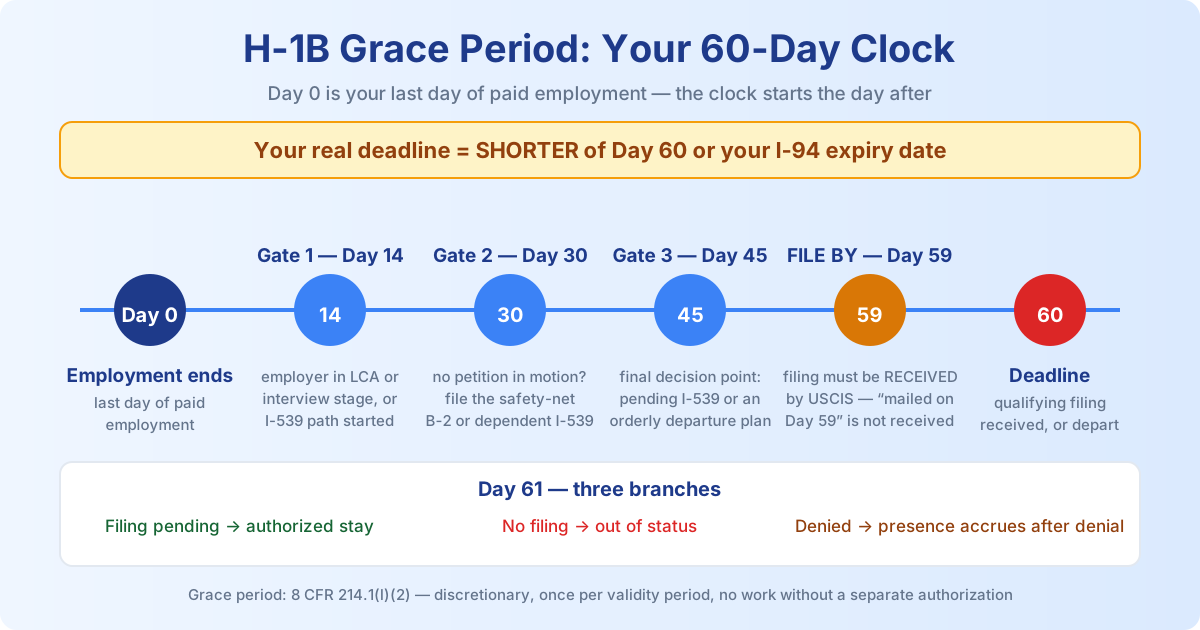
Your deadline is the shorter of two dates: 60 days after your last day of paid employment, or your I-94 expiry date. Work it out on Day 0 — not Day 59:
| Last day of paid employment | I-94 expiry | Your real deadline |
|---|---|---|
| March 15 | After May 14 | May 14 (grace begins March 16, 60 consecutive days end May 14) |
| March 15 | 20 days later | 20 days, not 60 — the I-94 cap cuts the period short |
| March 15 | 25 days later | 25 days, not 60 — same cap, same result |
Practical rule used by every careful practitioner: file by Day 59, not Day 60. A filing on Day 60 itself carries a specific reported risk — USCIS may approve the petition but deny the extension of status, leaving you to consular-process from abroad. Do not let a deadline you control turn into a departure you did not plan.
Day-by-Day Action Plan
Day 0 — the day employment ends
- Confirm your last day of paid employment in writing — termination letter, not a verbal assurance.
- Download your most recent I-94 from the CBP I-94 website and save every I-797 approval notice and recent pay stub.
- Write down your two candidate deadlines (60 days out, and your I-94 date) and circle the shorter one. That is your real deadline.
Days 1–2 — get advice and start the search
- Consult an immigration attorney, even for one session — the discretionary nature of the grace period means your later filing should ask for a favorable exercise of discretion in its cover letter.
- Ask your former employer, in writing: will you withdraw the petition with USCIS and the LCA with DOL, and when? Ask about return transportation (covered below).
- Start sponsor outreach immediately. Use our sponsor match tool to find employers actually filing H-1B petitions in your role, and check any employer on our top sponsors list.
Week 1 — understand the new employer's clock
- Any new employer must first get a certified Labor Condition Application (LCA) from DOL — USCIS notes this generally takes about 7 working days — before it can file your I-129. That lead time comes out of your 60 days, which is why Week 1 matters more than Week 8.
- Decide your ranked paths (below) with your attorney. Do not wait for one path to fail before starting the next.
Days 14, 30, and 45 — decision gates
- Day 14: you should have at least one employer in active LCA or interview stages, or a filed I-539 path started.
- Day 30: if no employer petition is in motion, file the change-of-status safety net (B-2 or dependent status) rather than betting everything on a late hire.
- Day 45: final decision point. If no petition is filed, your realistic options are a pending I-539 or an orderly departure plan.
Days 50–59 — file, do not wait
- Every filing that must beat the deadline should be received by USCIS in this window. "Mailed on Day 59" is not "received on Day 59."
Day 60 — last filing and departure day
- If a qualifying filing is received today, you have done what the rule requires. If nothing is filed, today is the day to depart.
Day 61 — three branches (see the Day 61 section below)
- Timely filing pending → you remain in a period of authorized stay.
- No filing → you are out of status and accruing risk.
- Filing denied → unlawful presence accrues from the day after denial.
Path 1 — New Employer Petition (H-1B Portability)
This is the path that keeps you employed, and it is the one most guides get wrong on a single decisive point. Your new employer files Form I-129 (Petition for a Nonimmigrant Worker) with a certified LCA, requesting an amendment or extension of your status. If you are eligible for portability, you may begin work immediately after USCIS receives the nonfrivolous petition. That is USCIS's trigger — receipt by USCIS, not approval, and not the I-797C receipt notice. Several well-known guides say you must wait for approval or for the receipt notice; that is stricter than the rule. (Many attorneys still advise waiting for the receipt notice as a safety practice, because the notice is your proof of receipt — that is practical advice, not the legal trigger.)
Portability has conditions: you must have been lawfully admitted, the petition must be nonfrivolous and filed before your authorized stay expires, and you must not have worked without authorization since your last admission. If the petition is denied, portability work authorization ends. Premium processing is available on Form I-907 (15 business days for I-129 petitions) — check the current USCIS fee schedule before filing, as fees change.
Two more points practitioners flag: if your former employer has not withdrawn its petition and it is still valid for the same position, a rehire can mean resuming work with no further filing — but if the employer notified USCIS to revoke the petition, a new petition is required. And cap-exempt employers (universities, nonprofit or government research organizations, and their affiliates) can hire outside the annual cap at any time, which can matter when the clock is short. Our H-1B transfer guide walks through fees, timeline, and eligibility in detail.
Path 2 — Change to B-2 Visitor Status (the Bridge)
File Form I-539 (Application to Extend/Change Nonimmigrant Status) before your grace period ends, requesting a change to B-2 visitor status. Understand exactly what this buys: a timely, nonfrivolous I-539 gives you a period of authorized stay while it is pending — it does not itself grant B-2 status. USCIS must approve it, and B-2 admission is typically up to 6 months.
B-2 does not permit work — B-2 visitors are barred from skilled and unskilled labor — but job search and interviews are permissible visitor activities. Expect scrutiny in 2026: a B-2 request whose only visible purpose is open-ended job hunting draws more questions than one showing temporary intent, funds, and a departure plan. If a new employer later files an I-129, USCIS generally processes the pending I-539 together with it. Do not file B-2 as a stalling tactic with no plan behind it.
Path 3 — Change to Dependent Status (H-4, L-2, and Others)
If your spouse holds qualifying status, file Form I-539 to change to dependent status (H-4, L-2, or another applicable classification) before the grace period ends. The same authorized-stay mechanics apply as with B-2: pending means authorized stay; approval means the status itself.
Work follows different rules by classification. Spouses in E and L status may be work-authorized incident to status. An H-4 spouse cannot work until H-4 status is approved and, where required, a separate H-4 EAD is approved on Form I-765. H-4 EAD eligibility itself generally requires an approved I-140 (or an AC21 H-1B extension) for the principal worker. See our H-4 EAD guide for who qualifies, how to apply, and the current renewal rules.
Path 4 — Departure, Done Right
Depart on or before Day 60 or your I-94 expiry, whichever is shorter. Departure preserves a clean record and avoids unlawful-presence accrual — but understand what it costs: departure ends the grace period immediately, and it cannot be recaptured on re-entry. Returning later requires a new status basis (a new approved petition plus a visa, or another classification) and discretionary admission by CBP.
One claim you should make if it applies to you: on involuntary cessation, an H-1B employer must pay the reasonable costs of return transportation to your last place of foreign residence (8 CFR 214.2(h)(4)(iii)(E)). Ask for it in writing; do not assume it will be offered.
Beyond the Four Paths
USCIS's own guidance lists further options that do not fit the four-path frame, and one of them may fit you better:
- Adjustment of status (Form I-485) — if you are eligible and a visa number is available. A pending adjustment case has its own portability rules (INA 204(j) and Supplement J) — get attorney advice before assuming a job change is safe.
- Compelling circumstances EAD — for workers with an approved I-140, no visa number available, and compelling circumstances, via Form I-765 for up to 1 year. Understand the trade-off before choosing it: it gives a period of authorized stay, not nonimmigrant status, and from it you generally cannot change status or adjust status from inside the U.S. — consular processing would be required.
- Change to F-1 or another work classification — via I-539 (F-1, with a Form I-20) or a new employer's I-129 for another classification. Each has its own eligibility rules and timelines.
H-4 Spouse and Children During the Grace Period
Dependents get the same grace period as the principal worker — the regulation covers "his or her dependents" in the same sentence. And USCIS answers the most-asked dependent question directly: if your spouse has an EAD or employment authorization incident to status, that authorization remains valid during the maximum 60-day grace period. Several secondary guides hedge this point; USCIS does not.
But the second half matters just as much, and some guides overstate it: when the grace period ends without a new basis, derivative H-4 status ends with it, and the H-4 EAD becomes invalid for work even if the card's printed expiry date is later. Working after that point is unauthorized employment. This is the standard reading of derivative status — USCIS states the during-grace part directly; the post-grace consequence follows from how derivative status works.
The reverse move is also available: the worker can switch to H-4 status on Form I-539 if the spouse holds qualifying H-1B status — but cannot work until H-4 is approved and, where required, a separate H-4 EAD is approved. H-4 children must be under 21 and unmarried, and H-4 itself carries no work authorization.
Do not confuse this with a different, already-final change: the automatic extension of H-4 EADs while a renewal is pending has ended under a separate final rule. That is about renewals, not about validity during the grace period. Our H-1B extension guide covers that final rule in detail — read it alongside this guide, not instead of it.
Your Employer: Withdrawal, Wages, and the Return Ticket
Your former employer has its own paperwork, and it runs through two different agencies: it must notify USCIS to withdraw the petition, and separately withdraw the LCA with the Department of Labor (through the FLAG system). Ask for written confirmation of both.
A "bona fide termination" also stops the employer's wage obligation — until USCIS is notified, DOL may treat employment as active and hold the employer liable for back wages. That is the employer's liability, not yours, but it is why prompt written notice matters to both sides. And remember the separation that protects you: your clock runs from cessation of employment, not from the withdrawal letter. Several guides blur these two dates; do not let yours blur.
Green-Card Protection While the Clock Runs
A layoff does not automatically destroy a green-card case, but two rules decide what survives:
- I-140 priority date: your priority date is generally retained even if the employer later withdraws the I-140. But the beyond-six-year H-1B extension benefit is lost if the I-140 is withdrawn within 180 days of its approval. That 180-day line is the single most valuable date in this section — know where you stand against it.
- Pending I-485: portability under INA 204(j) (with Supplement J) can let you change employers on a pending adjustment case, under conditions your attorney must confirm. Do not assume a pending I-485 makes a job change safe.
Track both against your own dates with our priority date tracker, and read our I-140 processing time guide for how long each stage actually takes. Processing times for any new filing can be checked on our processing time tracker.
Money, Benefits, and Life Logistics
The immigration clock is not the only clock. Two benefits items deserve a line each: COBRA continuation coverage generally gives you 60 days to elect coverage, for up to 18 months — check your election notice immediately, because the election window runs alongside your grace period, not after it. And review your 401(k) and HSA options, your lease terms, and any non-compete clause in your severance agreement before you sign it — a non-compete can quietly close off the new-employer path.
Unemployment benefits are unsettled — do not assume an answer. Secondary sources conflict on this: some suggest H-1B workers are generally eligible for state unemployment insurance, while a DOL-based reading says benefits are generally unavailable during the grace period because it is not work authorization. Eligibility is state-specific and fact-specific. Check your state's rules and get advice before filing or assuming either answer. This guide deliberately does not state a national rule on this point.
The 2026 Proposal to Eliminate the Grace Period — What It Is, and Is Not
Proposal citation box (proposal only — not law)
- Title: "Eliminating the Discretionary 60-Day Grace Period"
- Citation: 91 FR 57807, Federal Register Vol. 91, No. 175, Friday, September 11, 2026 (FR Doc. 2026-18631)
- Docket: USCIS-2026-0364; RIN 1615-AD22; 8 CFR Parts 204 and 214
- Comments due: November 10, 2026, before midnight Eastern Time, via the Federal eRulemaking Portal (regulations.gov) only — mailed and hand-delivered comments are not accepted at this time
- What it would delete: 8 CFR 214.1(l)(2) — the up-to-60-day discretionary grace period — restoring the pre-2017 policy of no grace period
- Status as of October 30, 2026: proposal only. No final rule, no effective date. The current rule remains in effect.
If finalized as written, an affected worker whose employment ends would generally be expected to depart immediately upon failure to maintain the employment or activity that formed the basis of status, unless otherwise authorized to remain. The separate 10-day periods at the edges of a validity period are not what this proposal deletes — but they do not help a mid-petition job loss in any case, so they are not a substitute.
What to do now, while it is still only a proposal:
- Do not change a sound plan based on a rule that does not yet exist — but do not assume a future cushion either. If a job loss is possible, get the safety-net filing (I-539) ready before you need it.
- If you can quantify business impact, consider commenting on docket USCIS-2026-0364 before November 10, 2026. DHS must review comments before deciding to finalize, modify, or abandon the proposal.
- Track the docket on regulations.gov and watch for a final rule — a final rule would set its own effective date, and controversial rules routinely take many months and face litigation.
- Re-check this guide after November 10, 2026. Anything written before the comment deadline is, by definition, written before the story ends.
Never write or repeat this as "the grace period has been eliminated." Until a final rule publishes, that sentence is false.
Misconceptions Corrected
| Myth | Correction |
|---|---|
| Severance / PTO extends my 60 days. | No — not automatically. The USCIS test is the last day salary or wage is paid. Severance after your last working day is generally compensation for job loss, not payment for services. The exception is narrow: remaining an active, paid employee (garden leave / notice period) is fact-dependent. |
| The 60 days are automatic / guaranteed. | No — discretionary. DHS may shorten or eliminate it case by case, and USCIS confirms it only on adjudication of your later filing. |
| I can work during the grace period. | No. Status is not work authorization. The only work routes are separate authorizations — portability on a properly filed I-129, a valid dependent EAD, a compelling circumstances EAD, and the like. |
| My I-94 date doesn't matter; I always get 60 days. | Wrong. The I-94 / validity end is a hard cap: whichever is shorter. And the visa stamp is not the deadline — the I-94 is. |
| There's a 90-day / 120-day / 180-day grace period. | No. Those figures come from old confusion and an unimplemented recommendation. The regulation says 60. |
| The 10-day period covers my layoff. | No. The 10-day period attaches to the edges of a completed validity period, not to a mid-petition termination — and it cannot be stacked onto the 60 days. |
| I can travel and come back on my grace period. | No. Departure ends the grace period immediately; it cannot be recaptured. Re-entry needs a new status basis and CBP admission. |
| The grace period has already been eliminated (2026 proposal). | No. Proposal only, comments due November 10, 2026, no final rule. The current rule still applies. |
| Filing I-539 gives me the new status. | No. A timely, nonfrivolous filing gives a period of authorized stay while pending; the status itself requires approval. |
| If I miss Day 60 by one day I'm automatically barred for 3 years. | No. Bars attach on departure after unlawful presence accrues (more than 180 days → 3-year bar; one year or more → 10-year bar). A timely filing pending past Day 60 means authorized stay, not unlawful presence. |
Day 61: Three Branches, Three Very Different Outcomes
Branch 1 — a timely, nonfrivolous filing is pending. You remain in a period of authorized stay even past Day 60, and unlawful presence is tolled while the filing is pending (provided there was no unauthorized work before or while it was pending). If that filing is denied, unlawful presence accrues from the day after denial — and an appeal or motion (Form I-290B) does not stop that accrual.
Branch 2 — no qualifying filing, still in the U.S. You are no longer maintaining status. USCIS's own framing is that the worker and dependents "may then need to depart" by the deadline — not after it. Every additional day is out-of-status time, and it is the accrual of unlawful presence, followed by departure, that triggers the 3-year and 10-year bars — not Day 61 itself.
Branch 3 — filing denied. Portability work authorization (if any) ends, and unlawful presence starts accruing the day after denial. This is the branch where an attorney's advice matters most, immediately — not next week.
One related rule worth knowing: if you were terminated while abroad and received no notice, or the notice period ended before your return, the grace period does not apply in the way it would for a worker terminated inside the U.S. Talk to an attorney before attempting re-entry on an old status.
Documents Checklist and Filing Checklist
Keep these together from Day 0 — USCIS adjudicates your later filing on paper, and the paper you saved on Day 0 is the paper that decides it:
- Termination letter stating your last working day, and your severance agreement (read the non-compete before signing).
- Most recent I-94 (from the CBP I-94 website) and every I-797 approval notice.
- Recent pay stubs and final pay statement — these prove your last day of paid employment.
- Your employer's written confirmation of petition and LCA withdrawal (or non-withdrawal).
- Prior I-140 approval notice and priority date, if any.
- Dependent documents: spouse's status evidence, H-4 EAD card, and children's status records.
| Form | Who files it | What it is for |
|---|---|---|
| I-129 | New employer | H-1B petition — change of employer / portability, with a certified LCA |
| I-539 | You (or your spouse, for dependent status) | Change to B-2, H-4, L-2, F-1, or another nonimmigrant status |
| I-765 | You / your spouse | Employment authorization — H-4 EAD or compelling circumstances EAD |
| I-485 | You | Adjustment of status, if eligible and a visa number is available |
| I-907 | Employer (or you, where applicable) | Premium processing request — 15 business days for I-129 petitions |
H-1B Grace Period: Frequently Asked Questions
How long is the H-1B grace period after a layoff?
Up to 60 consecutive calendar days, or until your authorized validity period (I-94) ends, whichever is shorter — under 8 CFR 214.1(l)(2). It is discretionary, applies once per authorized validity period, and does not itself authorize work.
When does the 60-day grace period start?
The day after termination of employment, typically determined by the last day for which a salary or wage is paid. Severance paid after your last working day does not automatically move the clock; if you remain an active, paid employee on garden leave or a notice period, the date is fact-dependent.
Does severance pay extend the H-1B grace period?
Not automatically. USCIS applies the "last day salary or wage is paid" test, and severance is generally compensation for job loss, not payment for services rendered. Lump-sum severance or PTO paid after your last working day does not by itself push the start date later.
Can I work during the 60-day grace period?
No — the grace period preserves status, not work authorization. The exception is a separate authorization: an eligible H-1B worker may begin work for a new employer immediately after USCIS receives a nonfrivolous I-129 petition (portability). A valid dependent EAD or a compelling circumstances EAD are other separate bases.
Can I change employers during the grace period, and when can I start work?
Yes. Your new employer files Form I-129 with a certified LCA before your grace period ends. If you are eligible for portability, you may begin work immediately after USCIS receives the nonfrivolous petition — the legal trigger is receipt by USCIS, not approval and not the receipt notice (though many attorneys advise waiting for the notice as a safety practice). If the petition is denied, portability work authorization ends.
What happens if I don't find a job within 60 days?
It depends on whether you filed something in time. A timely, nonfrivolous filing pending past Day 60 keeps you in a period of authorized stay. With no qualifying filing, you are out of status after the grace period ends and should depart by the deadline to avoid unlawful-presence accrual.
What happens on day 61?
Day 61 is not an automatic 3-year bar. With a timely filing pending, you remain in authorized stay; unlawful presence is tolled while it is pending and restarts the day after a denial. With no filing, you are out of status and accruing risk; the 3-year and 10-year bars attach on departure after more than 180 days or one year or more of unlawful presence, respectively.
Can I travel outside the US during the grace period?
You can depart, but departure ends the grace period immediately and it cannot be recaptured on re-entry. Re-entry requires a new status basis and CBP admission, which is discretionary. Do not travel on the assumption that your old status will still be waiting when you return.
Can my H-4 spouse keep working on H-4 EAD during the grace period?
Yes — USCIS states directly that an H-4 spouse's EAD or employment authorization incident to status remains valid during the maximum 60-day grace period. But when the grace period ends without a new basis, derivative H-4 status ends with it, and the EAD becomes invalid for work even if the card's printed expiry date is later.
Can I change to B-2, H-4, or F-1 status during the grace period?
Yes, by filing Form I-539 before the grace period ends. A timely, nonfrivolous filing gives you a period of authorized stay while it is pending, but the new status itself requires approval. B-2 does not permit work; H-4 work requires a separate approved H-4 EAD.
Is the grace period automatic, or can USCIS deny or shorten it?
It is discretionary — the regulation says DHS may eliminate or shorten it as a matter of discretion, and USCIS decides when adjudicating your later filing. There is no form to apply for it. Ask for a favorable exercise of discretion in your later filing's cover letter.
Can I use the grace period more than once?
Once per authorized validity period. A new employer and a new validity period can give rise to a fresh grace period on a later termination. Returning to the same employer on the same petition does not reset it.
Does the grace period apply if I quit instead of being laid off?
Yes. USCIS confirms the grace period may apply to both voluntary and involuntary cessation of employment. Resignation counts the same way a layoff does — the clock still runs from the day after employment ends.
What is the difference between the 60-day and 10-day grace periods?
The 60-day period (8 CFR 214.1(l)(2)) applies when employment ends before the validity period ends — a layoff, resignation, or termination. The 10-day period (8 CFR 214.1(l)(1)) attaches to the edges of a completed validity period: up to 10 days before it begins and 10 days after it ends. The 10-day period does not cover a mid-petition layoff, and it cannot be stacked onto the 60 days.
Has the 60-day grace period been eliminated in 2026?
No. DHS has only proposed eliminating it (91 FR 57807, September 11, 2026, docket USCIS-2026-0364, comments due November 10, 2026). The current rule in 8 CFR 214.1(l)(2) remains in effect until a final rule is published with its own effective date.
Sources
- U.S. Citizenship and Immigration Services — Options for Nonimmigrant Workers Following Termination of Employment (archived page, as cited in research)
- Cornell Legal Information Institute — 8 CFR 214.1 (regulation text, including (l)(1) and (l)(2))
- Federal Register via Justia — "Eliminating the Discretionary 60-Day Grace Period," 91 FR 57807, September 11, 2026 (FR Doc. 2026-18631)
- Federal eRulemaking Portal (regulations.gov) — Docket USCIS-2026-0364 (comments due November 10, 2026)
- U.S. Customs and Border Protection — I-94 website (retrieve your most recent I-94 record)
Last checked: October 30, 2026. This guide will need re-checking after November 10, 2026 (comment deadline for the elimination proposal) and again if a final rule publishes. This is general information, not legal advice — consult a qualified immigration attorney for your specific situation.