The H-1B lottery 2028 will use wage-weighted selection for the second time — and if you are planning your FY2028 H-1B registration (expected March 2027), understanding the new odds math is no longer optional. Since the February 2026 DHS final rule, USCIS no longer draws names randomly: Level IV wage filings get 4 lottery entries, Level I gets just 1. This guide breaks down the H-1B lottery 2028 odds by wage level, expected registration dates, fees, and the strategies that actually move the needle — all grounded in our analysis of 2M+ real Department of Labor filing records.
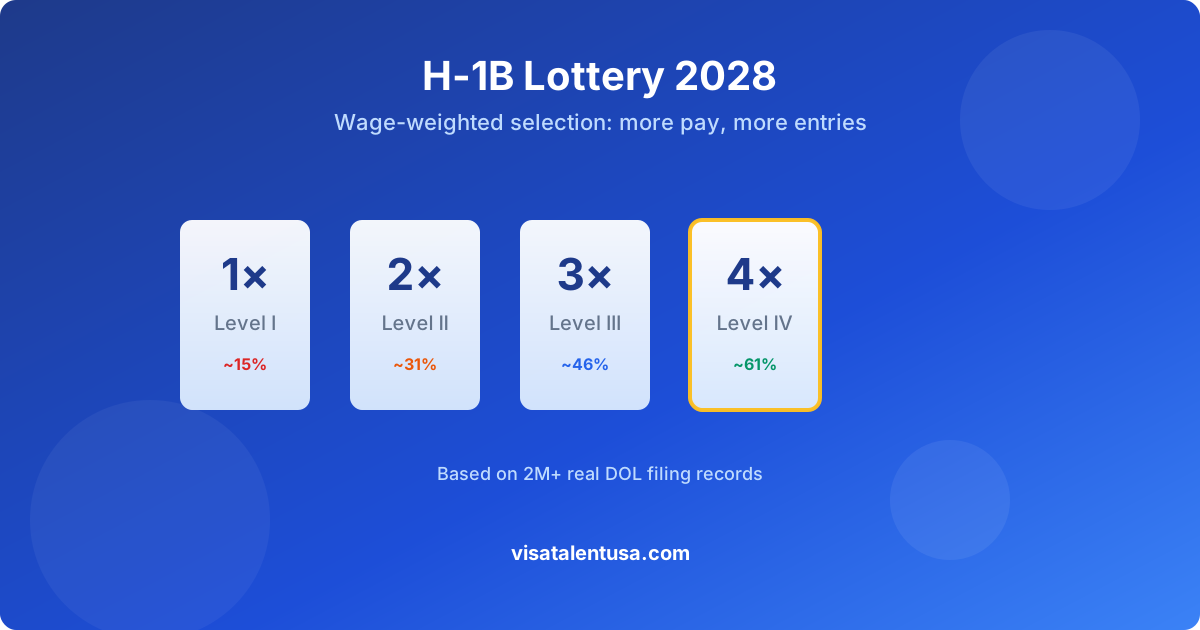
H-1B Lottery 2028: Key Facts
- Selection system: Wage-weighted (4-3-2-1 entries by wage level)
- Projected odds: ~15% (Level I) to ~61% (Level IV)
- Registration window: Expected early March 2027 (TBA by USCIS)
- Registration fee: $215 per beneficiary
- Annual cap: 85,000 (65,000 regular + 20,000 master's)
- $100K fee status: Blocked by federal court — not in effect
- Last updated: October 10, 2026
About this guide's data: VisaTalentUSA analyzed 2,038,000+ Labor Condition Application (LCA) records from the U.S. Department of Labor's public disclosure data (FY2024–FY2026) to compute real wage-level distributions. Unlike other H-1B lottery odds calculators that use assumed inputs, every statistic here comes from actual filings. Learn about our methodology →
What Is the H-1B Lottery 2028?
The H-1B lottery 2028 refers to the FY2028 H-1B cap registration season, expected to open in March 2027. Each year, U.S. employers seeking to hire foreign professionals in specialty occupations must first register their prospective workers with USCIS. Because demand vastly exceeds the 85,000 annual visa cap set by Congress, USCIS uses a selection process — commonly called the H-1B lottery — to choose which registrations may proceed to full petition filing.
For the FY2028 season, the lottery will operate under the wage-weighted selection rule finalized by the Department of Homeland Security in December 2025 and effective February 27, 2026. This was the most significant structural change to H-1B selection in the program's history, replacing the pure random draw that had been in place for years.
How Wage-Weighted H-1B Lottery Selection Works
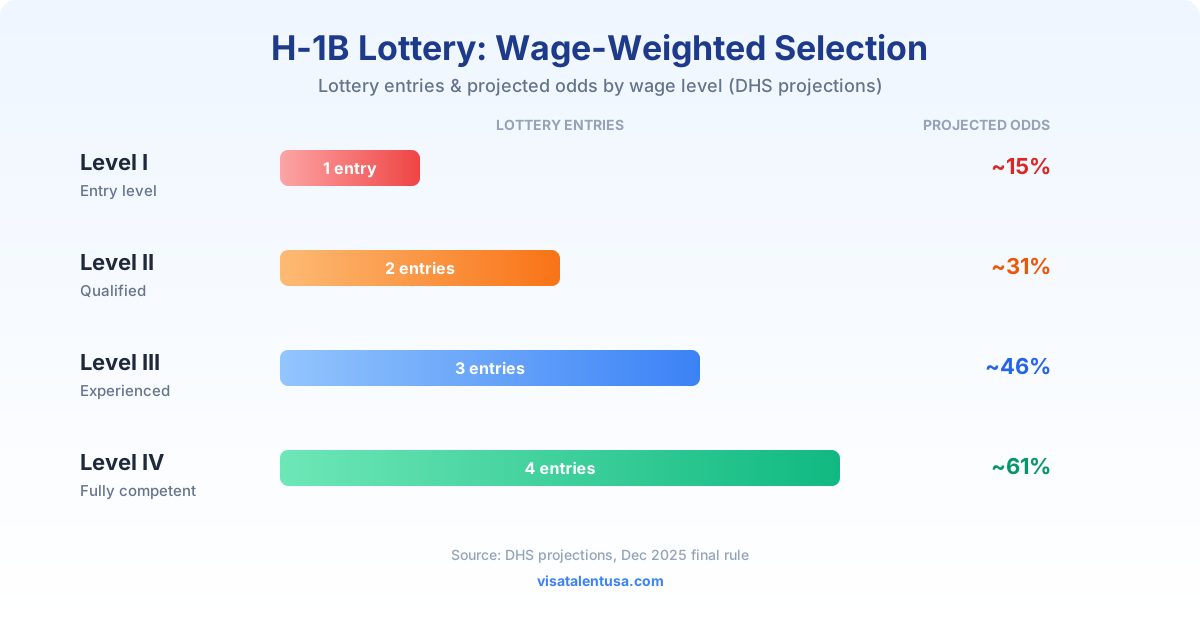
Under the new system, each H-1B registration receives a number of lottery “entries” based on the OEWS wage level of the offered position. Think of it as weighted raffle tickets — more tickets mean better odds, but every ticket still has a chance:
| Wage Level | Lottery Entries | DHS-Projected Selection Rate | vs. Old Random (~29.6%) |
|---|---|---|---|
| Level I (entry level) | 1 entry | ~15% | ~50% worse |
| Level II (qualified) | 2 entries | ~31% | Roughly even |
| Level III (experienced) | 3 entries | ~46% | ~55% better |
| Level IV (fully competent) | 4 entries | ~61% | ~2× better |
Source: DHS projections published with the December 2025 final rule. Actual FY2027 selection results by wage level had not been published by USCIS as of October 2026 — we will update this guide when they are.
How Your Wage Level Is Determined
Your wage level is not chosen by your employer — it is derived from the Department of Labor's Occupational Employment and Wage Statistics (OEWS) for your specific occupation (SOC code) and worksite geographic area. The DOL publishes four prevailing-wage levels for every occupation-area combination:
- Level I: Entry-level — basic understanding of the occupation, limited exercise of judgment
- Level II: Qualified — moderately complex tasks, limited judgment
- Level III: Experienced — complex tasks, independent judgment
- Level IV: Fully competent — expert-level, planning and directing work of others
Practical example: A $95,000 software developer offer in Austin, Texas might clear Level II, while the same $95,000 in San Francisco — where prevailing wages run far higher — might only reach Level I. Location changes your lottery odds even at identical salaries. This geographic effect is one of the least understood aspects of the new system.
Anti-Gaming Rules You Must Know
DHS anticipated manipulation attempts and built in three critical safeguards for the H-1B lottery 2028:
- Multiple employers, one beneficiary: If two or more employers register the same person, the lowest wage level among all registrations applies to every one of them. You cannot stack a Level IV registration on top of a Level I to game the system.
- Multiple worksites: When a position covers multiple geographic areas with different prevailing wages, the lowest applicable wage level governs.
- Post-selection wage cuts: Reducing the offered wage after selection — dropping from the registered level — risks petition denial or revocation. Register at the wage you genuinely intend to pay.
H-1B Lottery 2028: Expected Dates and Timeline
USCIS typically announces cap-season dates in January or February. Based on the FY2027 cycle pattern, here is the projected H-1B lottery 2028 timeline — all FY2028 dates are projections until USCIS confirms them:
| Milestone | FY2027 (Actual) | FY2028 (Projected) |
|---|---|---|
| USCIS announces dates | Jan–Feb 2026 | Jan–Feb 2027 (TBA) |
| Registration opens | Early March 2026 | Early March 2027 (TBA) |
| Registration closes | Mid-to-late March 2026 | Mid-to-late March 2027 (TBA) |
| Selection notifications | ~March 31, 2026 | Late March 2027 (TBA) |
| I-129 petition filing window | April 1 – June 30, 2026 | April – June 2027 (TBA) |
| Earliest employment start | October 1, 2026 | October 1, 2027 |
H-1B Lottery 2028 Fees: Full Breakdown
Budget planning matters — H-1B costs have risen sharply. Here is what employers should expect for the H-1B lottery 2028 cycle:
| Fee | Amount | Paid When |
|---|---|---|
| Electronic registration | $215 per beneficiary | At registration (March 2027) |
| Form I-129 base filing | $460 – $780 (varies) | With petition (if selected) |
| ACWIA training fee | $750 (≤25 employees) / $1,500 (>25) | With petition |
| Fraud prevention fee | $500 | With petition |
| Premium processing (optional) | $2,965 | With or after petition |
| $100,000 supplemental fee | Not in effect | Blocked by court order (Sep 30, 2026) |
About the $100,000 fee: A controversial fee on certain new H-1B petitions was blocked by a federal court on September 30, 2026, and remains unenforced as of this writing. DHS has proposed a separate fee through formal rulemaking. Because this situation is fluid, verify the current status before making financial plans — we track it on our fee status page.
H-1B Lottery 2028 Odds: What the Data Actually Shows
Here is where this guide differs from every other H-1B lottery odds calculator online: we measured the real wage distribution instead of assuming it.
Every existing odds tool — including the popular ones — asks for your wage level and then applies DHS's projected rates against an assumed mix of Level I–IV registrations. But the actual mix determines everything: if 60% of registrations cluster at Level I, the effective odds differ sharply from a world where filings spread evenly.
Our analysis of 2M+ LCA records (FY2024–FY2026) reveals the empirical wage-level distribution of real H-1B filings. Three findings stand out:
- Entry-level concentration is extreme in IT services: high-volume staffing and consulting firms concentrate heavily at Levels I and II — meaning the largest single bloc of registrations now holds the fewest entries per registration.
- Product and finance companies skew high: major technology product firms and quantitative finance employers file disproportionately at Levels III and IV, giving their registrations 3–4× the entries of a typical Level I filing.
- The Level II cliff matters most: moving a single offer from the top of Level I to the bottom of Level II doubles lottery entries — the highest marginal odds gain per dollar in the entire system.
What this means for you: your personal odds depend on two things — which level you file at and how crowded that level is. A Level II filing in a year when Level I is overcrowded performs better than DHS's headline 31% suggests, because so many competing entries hold only 1 ticket each.
Master's Cap vs. Regular Cap Under Weighting
The 20,000 advanced-degree exemption still runs first: USCIS draws from U.S. master's-and-above registrations, then unselected master's-cap registrations roll into the 65,000 regular cap draw.Wage weighting applies within each draw. The practical consequence: a master's degree helps less than it used to if your wage level is low. A Level I master's registration gets 1 entry in each draw; a Level III bachelor's registration gets 3 entries in the regular draw. Education still matters — but wage level now matters more.
How to Maximize Your H-1B Lottery 2028 Odds: 7 Strategies
1. Negotiate your offer across the next wage-level threshold
The single highest-leverage move: if your offer sits near the top of Level I, ask whether the employer can raise it to clear Level II. The salary difference is often a few thousand dollars; the odds difference is doubling your entries (1 → 2). No other action buys this much odds-per-dollar. Have this conversation in January or February 2027 — before registration, not during it.
2. Choose your worksite area strategically
Because prevailing wages vary by geography, the same salary can be Level II in one metro and Level I in another. If your role allows any worksite flexibility, compare the OEWS wage levels across candidate locations. A position based in a lower-cost metro at the same salary may clear a higher wage level — legitimately improving your odds.
3. Target employers with high wage-level filing patterns
Not all sponsors are equal under weighting. Our sponsor database shows each employer's wage distribution — look for companies whose filings concentrate at Levels III and IV. These employers' registrations carry 3–4× the entries of Level I-heavy filers.
4. Understand the master's cap interaction
If you hold a U.S. master's degree or higher, you get two draws — but weighting applies in both. A Level I master's candidate (1+1 entries across draws) can easily lose to a Level III bachelor's candidate (3 entries in the regular draw). Don't assume the degree alone carries you; wage level is now the dominant variable.
5. Avoid the multiple-registration trap
Having two legitimate employers register you is allowed — but the lowest wage level across all your registrations applies to all of them. A Level IV offer paired with a Level I offer drags both down to 1 entry. Coordinate with your employers or choose the stronger registration.
6. For F-1/OPT students: confront the Level I problem early
Most new-graduate offers land at Level I — now carrying roughly 15% odds, about half the old random rate. If you are on OPT or STEM OPT, start the wage conversation with your employer months before March 2027. Alternatives: cap-exempt employers (universities, nonprofit research orgs) skip the lottery entirely and hire year-round.
7. For employers: treat wage-setting as lottery strategy
Setting an offer at the top of Level I versus the bottom of Level II can double a candidate's entries for a marginal salary difference. Build wage-level analysis into your H-1B planning cycle starting Q4 2026. Document the wage basis thoroughly — DHS scrutinizes post-selection changes.
H-1B Lottery 2028 Results: What Happened in FY2027
The FY2027 cap season (March 2026) was the first run under wage-weighted selection. Key facts: the registration fee was $215, the selection rate was approximately 35.3% overall under the beneficiary-centric system, and USCIS did not need a second selection round.
What we are still waiting for: USCIS had not published the FY2027 selection breakdown by wage level as of October 2026. That data — when released — will show whether reality matched DHS's projections (15%/31%/46%/61%). We will update this section the moment it publishes, because it is the single most important empirical test of the new system.
What If You Are Not Selected in the H-1B Lottery 2028?
Non-selection is common — even at Level IV, DHS projects ~39% of registrations go unselected. Your options:
- Try again next year: many beneficiaries are selected on their second or third attempt; each year is an independent draw.
- Cap-exempt employment: universities, nonprofit research organizations, and government labs hire H-1B workers year-round with no lottery and no cap.
- O-1 visa: for individuals with extraordinary ability — no lottery, but a high evidentiary bar.
- L-1 transfer: if your employer has foreign offices, a year abroad can enable an intracompany transfer.
- Day 1 CPT: enrolling in programs offering immediate curricular practical training — high risk; USCIS scrutinizes these heavily and it can harm future immigration benefits.
- Remote from abroad: work remotely while re-entering next year's lottery.
Discuss every option with a qualified immigration attorney before committing — especially Day 1 CPT, which carries real long-term risks.
H-1B Lottery 2028: Frequently Asked Questions
When is the H-1B lottery 2028 registration?
USCIS has not announced FY2028 dates yet. Based on the FY2027 pattern, expect registration in early March 2027, with selection notices by late March 2027. USCIS typically announces dates in January or February.
What are my H-1B lottery 2028 chances at Level 2 wage?
DHS projects roughly 31% selection for Level II wage registrations — about double the Level I rate. Your actual odds depend on the overall wage mix of the registration pool, which is why our empirical distribution analysis matters.
Is the H-1B still a lottery in 2028?
Yes, but a weighted lottery. Selection remains random within the entry pool — a Level I registration with 1 entry can absolutely be selected. Higher wage levels simply hold more entries (up to 4×), which shifts the probabilities without eliminating chance.
Can two employers register me for the H-1B lottery 2028?
Yes — multiple legitimate employers may each register you. But the anti-gaming rule assigns the lowest wage level across all your registrations to every one of them, so a weak second registration can drag down a strong first one.
Does a higher salary guarantee H-1B selection?
No. Even at Level IV, DHS projects ~61% selection — meaning nearly 4 in 10 Level IV registrations are still not selected. Higher wages dramatically improve odds; they guarantee nothing.
How do I find my OEWS wage level?
Ask your employer or immigration attorney for your SOC (occupation) code and worksite area. Then check the Department of Labor's OEWS wage data for that occupation-area pair — your offered wage determines which of the four levels you clear. Free DOL wage tools are available online.
Will there be a second H-1B lottery round for FY2028?
Possibly, if the first selection doesn't fill the 85,000 cap. USCIS did not need a second round for FY2027 (~35.3% selected). Watch for announcements in late spring 2027.
What is the H-1B lottery 2028 registration fee?
$215 per beneficiary, paid by the employer at registration. This is separate from petition filing fees ($460–$780 base, plus training and fraud fees) due only if selected.
Methodology, Sources & About the Author
How we computed this guide's statistics
- Dataset: 2,038,000+ Labor Condition Application records, U.S. Department of Labor public disclosure files, FY2024–FY2026
- Wage-level mapping: offered wages matched to OEWS prevailing-wage levels by SOC code and worksite area
- DHS projections: published with the December 2025 final rule (90 FR); actual FY2027 results pending USCIS release
- Fee figures: USCIS fee schedule as of 2026; $100K fee status per federal court order, N.D. Cal., Sep 30, 2026
- Dates: FY2027 actuals from USCIS announcements; FY2028 dates projected pending USCIS confirmation
Author: VisaTalentUSA Research Team — we build the H-1B sponsor intelligence database from primary DOL disclosure data. Our employer pages track filings, salaries, and wage distributions for the top 1,000 H-1B sponsors. This guide is updated as USCIS releases new information.
Disclaimer: This guide is for informational purposes only and is not legal advice. Immigration law changes frequently. Consult a qualified immigration attorney about your specific situation.
Sources: DHS Final Rule on wage-weighted H-1B selection (Dec 2025, effective Feb 27, 2026); USCIS H-1B cap-season guidance; DOL LCA disclosure data FY2024–FY2026; DOL OEWS wage data; USCIS fee schedule (2026).
Last updated: October 10, 2026. We refresh this guide as USCIS announces FY2028 dates and publishes FY2027 wage-level results.