 By Muhammad Talha
I-140 processing time is the question every employment-based green card applicant asks after PERM approval — and the answer in 2026 is better than it has been in years. USCIS decided half of all regular I-140 petitions in just 3.7 months in FY 2026, the fastest median since 2021. But your timeline depends heavily on your EB category, whether you pay for premium processing, and which service center handles your case. This complete guide breaks down current I-140 processing times by category with real USCIS data, explains premium processing, and shows exactly where I-140 fits in your green card journey.
I-140 Processing Time: Key Facts (October 2026)
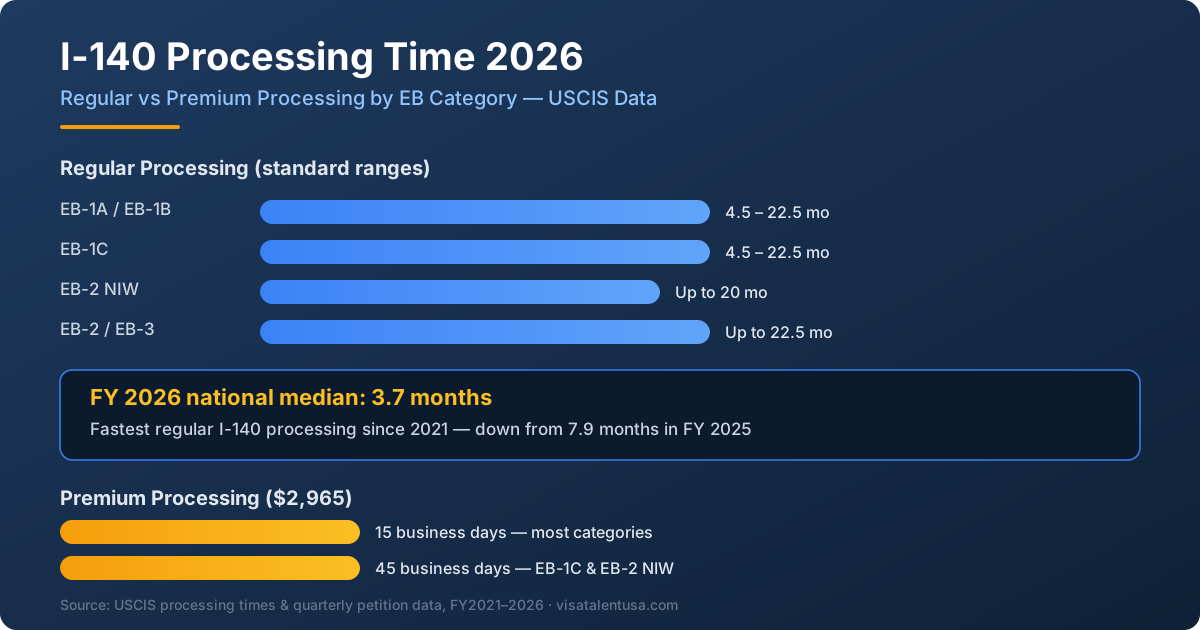
- National median (regular): 3.7 months in FY 2026 — fastest since 2021, down from 7.9 months in FY 2025
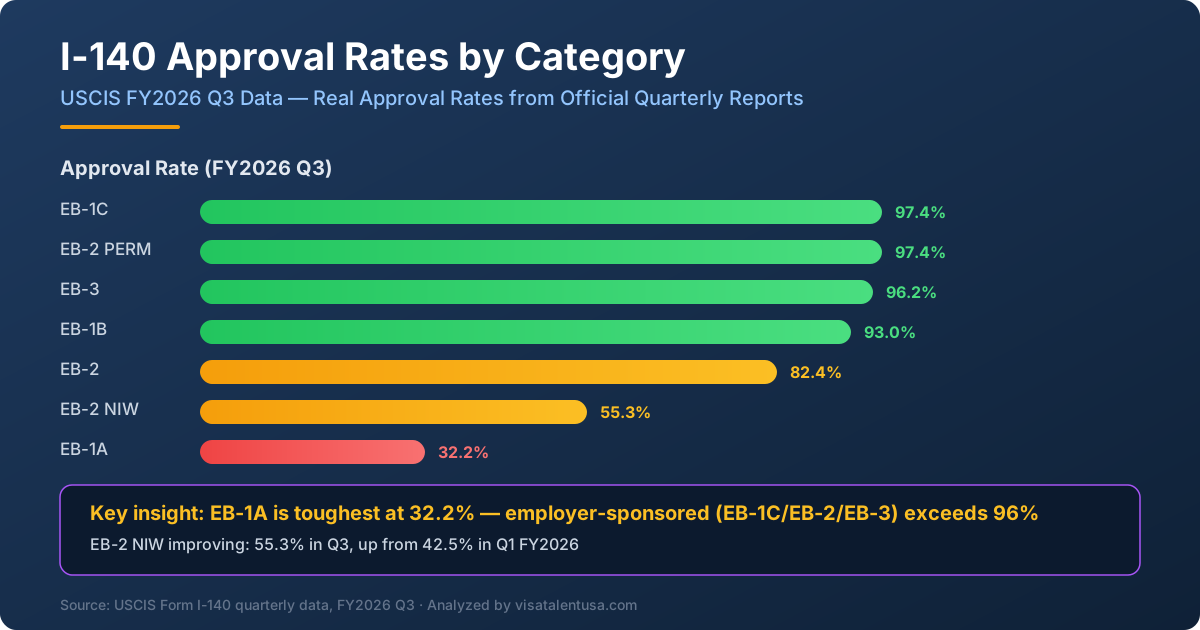
- Approval rates vary wildly: EB-1A only 32.2%, EB-2 NIW 55.3%, but EB-1C/EB-2 PERM/EB-3 all above 96% (USCIS FY2026 Q3 data)
- Premium processing: $2,965 fee; 15 business-day guarantee for most categories, 45 business days for EB-1C and EB-2 NIW
- Base filing fee: $715 for Form I-140 (plus applicable Asylum Program fee)
- By category range: 4.5–22.5 months standard across EB categories; EB-2 NIW up to 20 months at some centers
- What comes before: PERM labor certification (typically 18–30 months) for EB-2/EB-3 — see our PERM processing time guide
- Official source: USCIS processing times page and quarterly petition data, updated regularly
What Is Form I-140 and Where Does It Fit?
Form I-140, Immigrant Petition for Alien Workers, is the USCIS petition your employer files (or you file yourself, for EB-1A and EB-2 NIW) to classify you under an employment-based green card category. It is step two of the standard employment-based green card pipeline:
- PERM labor certification (EB-2/EB-3 only) — DOL certifies no qualified U.S. workers available. Typically 18–30 months.
- Form I-140 — USCIS adjudicates the immigrant petition. This guide.
- Priority date waits — applicants from India and China often wait years for visa availability per the monthly Visa Bulletin.
- Form I-485 or consular processing — the final green card application once the priority date is current.
I-140 approval locks in your priority date — the single most important date in your green card journey. That is why processing speed here matters so much.
Current I-140 Processing Times by Category (2026)
USCIS publishes processing time ranges by form, category, and service center. Based on current USCIS data, here is what to expect:
| EB Category | Standard Processing | Premium Available? | Premium Guarantee |
|---|---|---|---|
| EB-1A (Extraordinary Ability) | 4.5 – 22.5 months | Yes | 15 business days |
| EB-1B (Outstanding Researcher) | 4.5 – 22.5 months | Yes | 15 business days |
| EB-1C (Multinational Executive) | 4.5 – 22.5 months | Yes | 45 business days |
| EB-2 NIW (National Interest Waiver) | Up to 20 months | Yes | 45 business days |
| EB-2 (PERM-based) / EB-3 | Up to 22.5 months | Available for some | Varies |
Source: USCIS processing times data, 2026. Ranges vary by service center; check the USCIS processing times tool for your specific category and center.
I-140 Processing Is Faster Than Any Year Since 2021
Here is the trend that matters most. USCIS historical data shows regular I-140 processing hit its fastest median in years:
| Fiscal Year | Regular I-140 Median | Premium I-140 Median |
|---|---|---|
| 2021 | 8.2 months | 0.4 months |
| 2022 | 9.3 months | 0.3 months |
| 2023 | 4.3 months | 0.3 months |
| 2024 | 7.1 months | 0.3 months |
| 2025 | 7.9 months | 0.7 months |
| 2026 (through June 30) | 3.7 months ✅ | 1.2 months |
Regular processing more than halved from FY 2025 (7.9 months) to FY 2026 (3.7 months). Interestingly, premium processing medians have crept up — the premium clock's fine print (pauses for RFEs, clock restarts) means real-world premium timelines often exceed the nominal guarantee.
Real I-140 Approval Rates by Category (USCIS Quarterly Data)
Processing speed is only half the story. Our analysis of USCIS quarterly I-140 petition data (FY 2026 Q3, the latest published) reveals dramatic differences in approval rates across EB categories:
| EB Category | Received | Approved | Denied | Approval Rate |
|---|---|---|---|---|
| EB-1A (Extraordinary Ability) | 6,036 | 1,348 | 2,832 | 32.2% |
| EB-2 NIW (National Interest Waiver) | 13,831 | 3,835 | 3,103 | 55.3% |
| EB-1 (Overall) | 10,918 | 6,414 | 3,034 | 67.9% |
| EB-2 (Overall) | 29,307 | 15,989 | 3,426 | 82.4% |
| EB-1B (Outstanding Researcher) | 1,328 | 1,408 | 106 | 93.0% |
| EB-3 (Overall) | 22,707 | 15,572 | 609 | 96.2% |
| EB-1C (Multinational Executive) | 3,554 | 3,658 | 96 | 97.4% |
| EB-2 (PERM-based) | 15,476 | 12,154 | 323 | 97.4% |
Source: USCIS Form I-140 quarterly data, FY 2026 Q3 (Apr–Jun 2026). Analyzed by VisaTalentUSA from official USCIS publications. Approval rate = approved ÷ (approved + denied).
Key Insights From the Data
- EB-1A is the toughest: Only 32.2% approval rate — extraordinary ability has the highest evidentiary bar and the most denials (2,832 in one quarter).
- EB-2 NIW is improving: 55.3% approval rate in Q3, up from 42.5% in Q1 — the trend is moving in applicants' favor.
- Employer-sponsored is safest: EB-1C (97.4%), EB-2 PERM (97.4%), and EB-3 (96.2%) have the highest approval rates — the PERM labor certification does heavy lifting upfront.
- Volume leader: EB-2 received 29,307 petitions in Q3 — the largest category by far, driven by both PERM and NIW filings.
Premium Processing: Is the $2,965 Worth It?
Premium processing (Form I-907, $2,965 as of 2026) guarantees USCIS will take adjudicative action — approval, denial, RFE, or notice of intent to deny — within 15 business days for most I-140 categories, or 45 business days for EB-1C and EB-2 NIW.
Important: premium processing does NOT increase approval odds
USCIS applies the exact same legal standards whether or not you pay for premium. It only speeds up the decision timeline. A weak petition gets denied faster — not approved.
When premium processing makes sense:
- You need the I-140 approved quickly to preserve H-1B extensions beyond year 6
- Your priority date is near-current and every month counts
- Job portability (AC21) planning requires an approved I-140
- Employer is willing to pay (many do for key hires)
When to skip it:
- Your priority date is years away anyway (common for India/China EB-2/EB-3)
- The petition has any weakness — an RFE under premium clock creates time pressure
- Regular processing is already fast (3.7-month median in FY 2026)
What Slows Down I-140 Processing?
- Requests for Evidence (RFEs): The #1 delay. Ability-to-pay issues are the most common RFE trigger — USCIS scrutinizes whether the employer can pay the offered wage from the priority date onward.
- Incomplete petitions: Missing credential evaluations, experience letters, or financial documents.
- Service center workload: Texas and Nebraska centers historically carry heavier I-140 loads than others.
- Category complexity: EB-2 NIW requires adjudicators to evaluate the three-prong Dhanasar framework — inherently more subjective and variable than EB-1 credential review.
- PERM issues carrying over: If the underlying PERM had problems, USCIS may re-examine them at the I-140 stage.
How to Check Your I-140 Status
- USCIS Case Status Online: Enter your receipt number (three letters + ten digits, e.g., LIN2490123456) at egov.uscis.gov.
- USCIS Processing Times tool: Select Form I-140, your category, and service center for the current estimated range at egov.uscis.gov/processing-times.
- Ask your attorney/employer: They receive all notices. Beneficiaries often cannot see the full picture alone.
- e-Request / Service Request: If your case is outside normal processing times, file an online service request.
What Happens After I-140 Approval?
I-140 approval locks in your priority date. Then:
- Watch the monthly Visa Bulletin (Department of State) for your priority date to become current
- Once current: file Form I-485 (adjustment of status, if in the U.S.) or go through consular processing abroad
- After 180 days with a pending I-485, AC21 portability lets you change jobs in a same-or-similar role
For applicants from India and China in EB-2/EB-3, the Visa Bulletin wait — not I-140 processing — is the real bottleneck, often stretching 7–14+ years.
Coming from PERM?
If you are still in the PERM stage, read our complete PERM processing time guide with real DOL data — it is the step right before I-140 for EB-2 and EB-3 cases.
Official Sources
- USCIS Processing Times — official current estimates by form, category, and service center
- USCIS Form I-140 — official form page, instructions, and filing guidance
- USCIS Form I-907 — official premium processing request, fees, and eligible categories
- USCIS Immigration Data & Statistics — quarterly petition data by form type
- Visa Bulletin (Department of State) — monthly priority-date movement
Processing times are medians and ranges from USCIS-published data (FY 2021–2026) — individual cases vary. This guide is for informational purposes only and does not constitute legal advice. Consult a licensed immigration attorney for your specific situation.