 By Muhammad Talha
Effective tomorrow — Friday, October 23, 2026: USCIS is narrowing the rule that decides whether a filing deadline landing on a weekend or federal holiday rolls to the next business day. Under Policy Alert PA-2026-15, that cushion survives for deadlines counted in days — RFE and NOID response windows, appeal periods — but it disappears for deadlines tied to a specific date, including an H-1B worker's I-94 expiry and a child's 21st birthday. If your extension of stay is due on a Saturday, a paper filing that arrives Monday is now late. This guide explains exactly what changed, the three kinds of deadlines, worked examples on the real 2026 calendar, and what H-1B workers and employers should do before the weekend.
Key facts (Policy Alert PA-2026-15)
- What: USCIS Policy Alert PA-2026-15, "Definition of Day for Purposes of Filing Deadlines"
- Issued: September 23, 2026
- Effective: October 23, 2026 — applies to paper filings USCIS receives on or after this date
- Where it lives: USCIS Policy Manual, Volume 1, Part B, Chapter 6, Section E ("Filing Periods Ending on Weekends or Federal Holidays")
- Replaces: the March 2023 guidance (PA-2023-10), which had extended the weekend rule to birthday- and age-based deadlines
- Bottom line: day-counted paper deadlines still roll to the next business day; date-based eligibility cutoffs no longer do; electronic filings never did
The New Rule in Plain English
Everything in this change flows from one regulatory sentence. The immigration regulations at 8 CFR 1.2 define the word "day" for deadline purposes:
"Day, when computing the period of time for taking any action provided in this chapter I including the taking of an appeal, shall include Saturdays, Sundays, and legal holidays, except that when the last day of the period computed falls on a Saturday, Sunday, or a legal holiday, the period shall run until the end of the next day which is not a Saturday, Sunday, or a legal holiday."
— 8 CFR 1.2, definition of "day"
Read the first clause carefully: the definition applies when computing a period of time. PA-2026-15 says USCIS will now apply the weekend rule only where it belongs by its own terms — where a statute, regulation, or form instruction sets the deadline as a number of days. A deadline that is instead a substantive eligibility requirement — file before a date, file before a birthday — is not a "period of time" at all, and the regulation's definition of "day" does not move it.
Nothing about how days are counted inside a period changes. Saturdays, Sundays, and federal holidays still count toward your 30, 33, or 87 days. Only the last-day rule is being sorted into its proper scope — and for one category of filers, that sorting removes a safety net they have relied on since 2023.
The Three Kinds of Deadlines
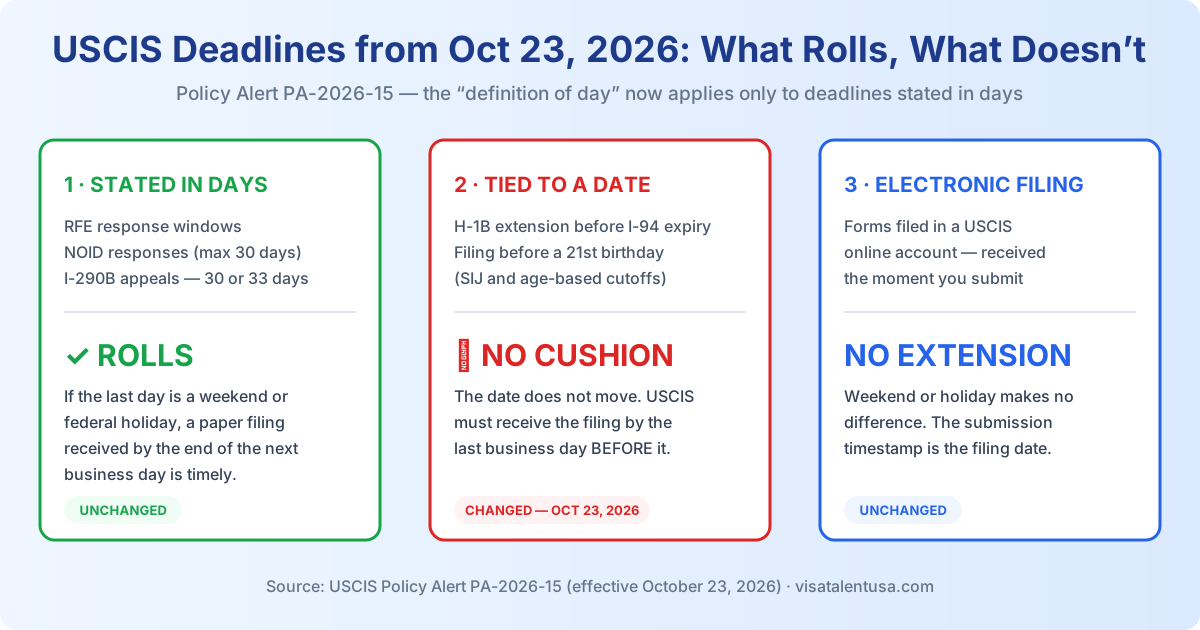
From October 23, 2026, every USCIS deadline falls into one of three buckets. Which bucket yours is in decides whether a weekend helps you or hurts you:
| Deadline type | Examples | If the last day is a Sat / Sun / federal holiday |
|---|---|---|
| 1. Stated in days | NOID response (max 30 days by regulation); RFE response window stated in the notice; Form I-290B appeal/motion period — 30 days if a denial is served in person, 33 days if served by mail | Rolls. A paper filing received by the end of the next business day is timely. Unchanged. |
| 2. Tied to a date or eligibility event | H-1B extension of stay that must be filed before the I-94 expiry date; a petition that must be filed before a child's 21st birthday (e.g., Special Immigrant Juvenile cases) | Does not roll. USCIS must receive the filing by the last business day before the date. Changed by PA-2026-15. |
| 3. Electronic filing | Any form or response submitted through a USCIS online account | Never rolls. The filing is deemed received the moment it is submitted. Unchanged. |
Two scope notes matter. First, the new guidance applies to paper filings USCIS receives on or after October 23, 2026 — a filing received on October 22 is judged under the old guidance even if its deadline falls later. Second, USCIS notes that some benefit types — including certain asylum-related procedures for evidence requests, intent-to-deny notices, denials, and terminations — are governed by different regulations, and this guidance does not apply to them. The notice or regulation governing your specific filing always controls.
Worked Examples
Example 1: An appeal deadline that still rolls (USCIS's own example)
The Policy Manual illustrates the surviving rule with a Form I-485 denial. If USCIS serves the denial by mail, the applicant has 33 days to file Form I-290B. In USCIS's example, that 33-day period ends on Sunday, September 4, and the following Monday is Labor Day. A paper I-290B received on Tuesday, September 6 — the next business day — is timely. Day-counted periods keep their cushion; nothing about this example changes on October 23.
Example 2: An H-1B extension that no longer rolls
Now the changed case. Suppose an H-1B employee's I-94 expires on Saturday, November 14, 2026 (that is the real 2026 calendar), and the employer is filing an extension of stay. An extension must be filed before the current stay expires — that is a deadline tied to a date, not a number of days. Under the 2023 guidance, a paper filing received on Monday, November 16 could be treated as timely. Under PA-2026-15, it is late. The paper filing must be received by Friday, November 13, 2026.
The stakes of getting this wrong are high. USCIS generally will not approve an extension of stay filed after the prior status has already expired; a narrow exception can excuse a late filing only where the delay resulted from extraordinary circumstances beyond the filer's control. And a timely filed H-1B extension is what allows the employee to keep working for the same employer for up to 240 days while the extension is pending — protection a late filing loses. One weekend of miscalculation can become a work-authorization crisis.
Example 3: A 21st birthday on a weekend
Some petitions must be filed while a child is still under a specified age — most clearly Special Immigrant Juvenile (SIJ) petitions, which must be filed before the child's 21st birthday. If that birthday falls on a Sunday, the filing does not move to Monday. USCIS must receive it by the preceding business day — the Friday before. Families and attorneys who built a "file it Monday" habit during 2023–2026 need to unbuild it now.
What the Rule Was Before: The 2023 Guidance
In March 2023, USCIS issued PA-2023-10, which read the definition of "day" broadly. For paper filings received on or after March 29, 2023, USCIS said the next-business-day rule applied not only to day-counted periods but also to "the last day before a requestor's or beneficiary's birthday" and "the last day of a qualifying time period" — and it confirmed the same treatment for mailed responses to Requests for Evidence and Notices of Intent to Deny, Revoke, Rescind, or Terminate.
For roughly three and a half years, then, weekend birthdays and weekend status-expiry dates carried an automatic cushion for paper filers. PA-2026-15 withdraws that reading and returns to the pre-2023 understanding: the definition of "day" governs the computation of periods stated in days, and nothing else.
Why USCIS Changed It: The Supreme Court Case
PA-2026-15 cites the Supreme Court's 2025 decision in Monsalvo Velasquez v. Bondi. There, the Court applied the next-business-day rule to a removal-related deadline — the 60-day voluntary departure period — whose final day fell on a Saturday. The critical point for USCIS's new reading: that period was itself stated in days in the statute, so the traditional computation rule attached to it. The decision supports applying the weekend rule to day-counted periods; USCIS reads it as saying nothing that extends the rule to substantive eligibility dates such as birthdays. The 2026 alert aligns the Policy Manual with that distinction.
What This Means for H-1B Workers and Employers
Although PA-2026-15 is a general filing rule, its sharpest edge lands on employment-based cases — and especially on H-1B extensions:
- Extensions of stay are date-deadlines. Your employer's I-129 extension must be filed before your I-94 expiry. If that date is a Saturday, Sunday, or federal holiday, the real paper-filing deadline is the business day before. Build your timeline from the H-1B extension process guide with this earlier cutoff in mind.
- RFE and NOID responses are day-deadlines. The response period printed in your notice is counted in days, weekends included, and a paper response still gets the next-business-day rule if the last day is a weekend or holiday. Note the trap in the other direction: "up to 30 days" for a NOID is a regulatory maximum — the period in your actual notice is what controls, and it may be shorter.
- Appeals and motions (Form I-290B) are day-deadlines. 30 days from in-person service, 33 days from mailed service — and the paper next-business-day rule still applies.
- Electronic filings never had a cushion. Anything submitted through a USCIS online account — including H-1B cap registrations — is received at the moment of submission. A deadline-day server problem at 11 p.m. is your problem, not USCIS's.
- Dependents aging out. Any filing whose eligibility depends on a child still being under 21 must be received before the birthday. If the birthday lands on a weekend, Friday is your deadline. Families should also ask their attorney how the Child Status Protection Act interacts with their specific filing — the age calculation and the filing deadline are separate questions.
For the official description of the H-1B program and employer filing obligations, see USCIS's H-1B Specialty Occupations page.
Action Checklist
If you are a worker or family member
- List every date-based deadline in your next 6 months: I-94 expiries, a dependent's 21st birthday, any "file before" date. If one falls on a weekend or federal holiday, your real deadline is the preceding business day.
- File extensions early. H-1B extensions can be filed up to 6 months before status expires. Early filing makes this entire rule irrelevant to you.
- Receipt date is what counts. For paper filings, timeliness is judged by when USCIS receives the package, not the postmark. Near a deadline, use a delivery method with tracking and proof of delivery.
- E-filing? Submit before the deadline day where you can — there is no weekend extension and no grace period for a last-minute submission.
If you are an employer or HR/immigration team
- Audit the renewal pipeline now: flag every I-94 expiry in the next two quarters that falls on a Saturday, Sunday, or federal holiday, and move those filing targets to the preceding Friday.
- Retire the 2023-era habit in your docketing systems: calendar software that auto-rolls a date-based deadline past a weekend is now a liability.
- Keep treating stated last days as real deadlines for RFE/NOID responses — the paper cushion exists, but planning around it invites courier and receipt-date risk.
Timeline: How We Got Here
- March 2023: USCIS issues PA-2023-10, extending the next-business-day rule to birthday and qualifying-period deadlines for paper filings received on or after March 29, 2023.
- 2025: The Supreme Court decides Monsalvo Velasquez v. Bondi, applying the weekend rule to a statutory period stated in days.
- September 23, 2026: USCIS issues PA-2026-15, narrowing the definition-of-day guidance back to day-counted deadlines.
- October 23, 2026 (tomorrow): PA-2026-15 takes effect for paper filings USCIS receives on or after this date.
Bottom line: if a deadline in your case is a date, the weekend no longer protects you — file so USCIS receives it before that date. If your deadline is a number of days and you file on paper, the next-business-day rule still has your back.
USCIS Filing Deadlines: Frequently Asked Questions
What is USCIS Policy Alert PA-2026-15?
PA-2026-15, issued September 23, 2026, updates the USCIS Policy Manual (Volume 1, Part B, Chapter 6, Section E) to clarify how the regulatory definition of "day" in 8 CFR 1.2 applies to filing deadlines. It takes effect October 23, 2026, for paper filings USCIS receives on or after that date.
What actually changed on October 23, 2026?
The next-business-day extension no longer applies to deadlines tied to a substantive eligibility date — such as filing before a 21st birthday or filing an H-1B extension of stay before an I-94 expiry date. It still applies to deadlines stated in days (RFE/NOID responses, I-290B appeal and motion periods) for paper filings.
My H-1B I-94 expires on a Saturday. When must my extension be filed?
USCIS must receive the extension before your current stay expires — for a paper filing, in practice by Friday, the last business day before the Saturday expiry. A package received on Monday is late under PA-2026-15, and USCIS generally will not approve an extension of stay filed after the prior status expired, apart from a narrow extraordinary-circumstances exception.
Do RFE and NOID deadlines still extend past weekends?
Yes — for paper responses. If the last day of the response period stated in your notice falls on a Saturday, Sunday, or federal holiday, a paper response received by the end of the next business day is timely. NOID responses are capped at a maximum of 30 days by regulation, and the exact period printed in your notice always controls.
Does the rule apply to online filings?
No. USCIS treats an electronic filing as received at the moment it is submitted, so online filings never receive a weekend or holiday extension — under the old guidance or the new one.
Does PA-2026-15 apply to filings USCIS received before October 23, 2026?
No. It applies to paper filings received on or after October 23, 2026. Filings received earlier are governed by the prior 2023 guidance, which did extend the weekend rule to birthday- and period-based deadlines.
What if a filing is due before my child turns 21 and the birthday is on a weekend?
The filing must be received before the birthday — by the preceding business day at the latest. Eligibility cutoffs do not move for weekends or holidays under the new guidance. This is the reverse of the 2023–2026 rule, so double-check any older advice you received.
Is PA-2026-15 a new law or regulation?
No. It is agency guidance interpreting the existing regulation at 8 CFR 1.2. It reverses USCIS's March 2023 guidance and returns to the pre-2023 reading of the definition of "day," citing the Supreme Court's 2025 decision in Monsalvo Velasquez v. Bondi.
Methodology & Sources
This guide is based on USCIS Policy Alert PA-2026-15 (September 23, 2026) and the updated USCIS Policy Manual text it produced (Volume 1, Part B, Chapter 6, Section E), the prior guidance it replaces (PA-2023-10, March 2023), and the regulatory definition of "day" at 8 CFR 1.2. The Form I-290B worked example is USCIS's own example from the Policy Manual. The November 2026 H-1B example applies the alert's rule to the actual calendar — November 14, 2026 is a Saturday — following the extension-of-stay scenario the alert's distinction creates. Immigration deadlines are fact-specific: verify your deadline against the notice or regulation that governs your filing, and confirm critical dates with your attorney.
Sources
- USCIS Policy Alert PA-2026-15 — "Definition of Day for Purposes of Filing Deadlines," September 23, 2026 (official USCIS document, PDF)
- USCIS Policy Manual — Volume 1, Part B, Chapter 6, Section E: "Filing Periods Ending on Weekends or Federal Holidays" (uscis.gov)
- 8 CFR 1.2 — regulatory definition of "day" for computing periods of time
- USCIS Policy Alert PA-2023-10 — "Filing Periods and Response Timeframes Ending on Saturdays, Sundays, or Federal Holidays," March 2023 (superseded guidance)
- Monsalvo Velasquez v. Bondi — U.S. Supreme Court (2025)
- USCIS — H-1B Specialty Occupations — program and employer filing guidance (uscis.gov)
Published: October 22, 2026. We will update this guide if USCIS issues further clarification. Not legal advice — consult a qualified immigration attorney for your specific situation.