PERM processing time is the number-one anxiety for every employment-based green card applicant — and in October 2026, the U.S. Department of Labor is taking an average of 336 calendar days (about 11 months) just for the analyst review stage. Add the prevailing wage determination (4–8 months), mandatory recruitment (2–3 months), and a possible audit, and the full PERM journey can stretch well past two years. This complete guide breaks down every stage of PERM processing in 2026 with real, current DOL data: how long each step takes, what the October 2026 priority-date movement means for your case, why some cases get audited, how to check your status, and exactly what to do while you wait.
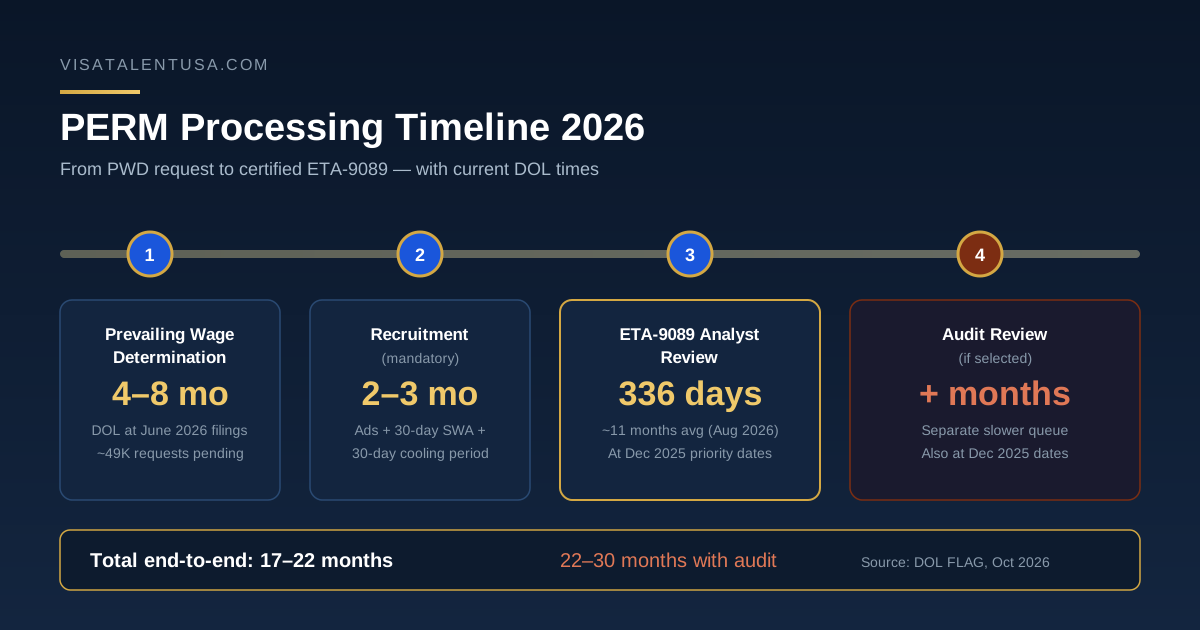
PERM Processing Time: Key Facts (October 2026)
- Analyst review average: 336 calendar days (~11 months) as of August 2026 — DOL is currently adjudicating cases with December 2025 priority dates
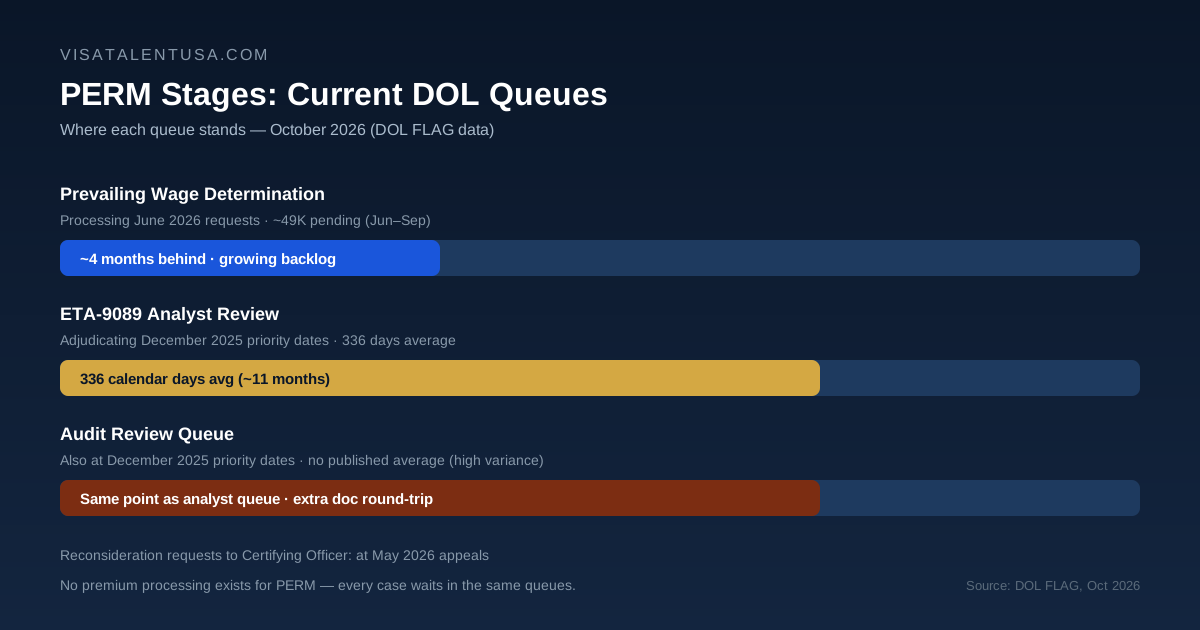
- Prevailing wage determination: DOL is processing June 2026 PWD requests (as of September 30, 2026) — roughly 4 months of backlog
- Audit review: Also working through December 2025 priority dates — audited cases join a separate, slower queue
- No premium processing: Unlike H-1B, there is no way to pay for faster PERM adjudication
- Full end-to-end timeline: Typically 18–30 months from PWD request to certified ETA-9089
- Official source: DOL FLAG processing times page, updated monthly
What Is PERM and Why Does It Take So Long?
PERM (Program Electronic Review Management) is the U.S. Department of Labor's system for processing permanent labor certifications — Form ETA-9089. It is the mandatory first step of most employment-based green card cases (EB-2 and EB-3). Before your employer can file Form I-140 with USCIS, DOL must certify that hiring you will not adversely affect U.S. workers — meaning no qualified, willing, and available U.S. worker was found for the position through a prescribed recruitment process.
The reason PERM takes so long is structural, not accidental. Every application passes through multiple sequential gates, each with its own queue: the prevailing wage determination (where DOL itself decides what the job should pay), a mandatory recruitment period (where the employer must test the U.S. labor market), and then the analyst review (where a DOL analyst examines the entire filing). A random or targeted audit can add many more months. And unlike most USCIS processes, there is no premium processing for PERM — no fee, no lawyer, and no congressional inquiry can move your case ahead of the queue.
Understanding each stage — and its current timeline — is the only real way to plan. Below is the complete breakdown with the latest official DOL figures.
PERM Processing Time in 2026: The Complete Timeline
A PERM case moves through four major stages. Here is how long each one is taking right now, based on DOL's official processing-times data published in October 2026:
Stage 1: Prevailing Wage Determination (PWD) — 4–8 Months
Before anything else, the employer must obtain a prevailing wage determination from DOL's National Prevailing Wage Center. The PWD sets the minimum wage the employer must offer — based on the job's SOC (Standard Occupational Classification) code, skill level, and worksite location. The employer cannot file the PERM application until the PWD is in hand, and the recruitment wages must meet or exceed it.
Current PWD timeline (as of September 30, 2026): DOL is processing PWD requests filed in June 2026 — for both OEWS-based and non-OEWS (survey-based) requests. That is roughly a 4-month backlog, and it is growing: DOL reported 3,532 PERM PWD requests still pending from June 2026, ballooning to 15,959 from July, 14,980 from August, and 14,519 from September. In practical terms, expect 4–8 months for your PWD, with complex or survey-based wage requests trending toward the longer end.
One underappreciated detail: the PWD is valid only for a limited window (generally tied to the wage data's validity period). If recruitment drags on too long after the PWD issues, the employer may need a redetermination — DOL is currently processing PERM redeterminations from July 2026. Build buffer into your planning.
Stage 2: Recruitment — 2–3 Months (Mandatory)
Once the PWD is issued, the employer must conduct a good-faith recruitment campaign to test whether any qualified U.S. workers are available. For professional positions, this means at minimum: two Sunday newspaper advertisements (or one Sunday ad plus a professional journal ad), a 30-day job order with the State Workforce Agency, an internal posting notice at the worksite for 10 consecutive business days, and at least three additional recruitment steps (job fairs, employer website posting, job search websites, campus recruiting, trade organizations, and similar).
The recruitment itself takes 60–90 days by regulation — the ads must run, the 30-day SWA posting must complete, and then there is a mandatory 30-day "cooling" period after the last ad before the PERM can be filed. This stage cannot be rushed or skipped; it is the legal foundation of the entire labor certification. After recruitment closes, the employer must also prepare the recruitment report documenting every applicant and the lawful reason each U.S. applicant was rejected.
Stage 3: ETA-9089 Filing and Analyst Review — ~11 Months
With recruitment complete, the employer files Form ETA-9089 electronically through the DOL FLAG system. The application's priority date — the date DOL accepts the filing — is locked in at this moment, and it determines the applicant's place in the green card queue for years to come.
Current analyst review timeline (as of October 5, 2026): DOL is adjudicating cases with December 2025 priority dates, and the average processing time for analyst review was 336 calendar days in August 2026 — roughly 11 months. In other words, a PERM filed today would, at current pace, expect a decision around September 2027. That average includes both approvals and denials, and individual cases vary with their facts — but it is the most honest single number for planning.
During analyst review, a DOL analyst verifies the employer's recruitment, the PWD, the job requirements, and the foreign worker's qualifications. Most cases are decided here without further contact — but a meaningful share are pulled into the audit queue instead.
Stage 4 (If Triggered): Audit Review — Additional Months
If DOL selects the case for audit, the employer receives an audit notification letter requesting the full recruitment file and supporting documentation — typically with a 30-day response deadline (plus a possible 30-day extension). The case then joins the separate audit review queue.
Current audit timeline (as of October 5, 2026): DOL's audit queue is also working through December 2025 priority dates — the same point as the regular queue, which tells you the audit queue is not dramatically behind right now, but audited cases still take longer overall because of the extra documentation round-trip. DOL does not publish a separate average-days figure for audits (listed as N/A), which itself signals high variability. Practically, an audit adds several additional months beyond the standard timeline.
Is PERM Processing Getting Faster or Slower?
The honest answer: it improved through mid-2026, then plateaued. The 336-day analyst-review average reflects real progress from the worst periods — but DOL's queues remain deep. Consider the PWD backlog alone: nearly 49,000 PERM prevailing wage requests were still pending across June–September 2026 filings. Until that backlog compresses, end-to-end timelines cannot shorten much further.
Seasonal patterns matter too. Search interest and filing volumes reliably surge from October through April (H-1B season spillover and fiscal-year planning), then soften in summer. If your employer has flexibility on timing, initiating the PWD in late spring or summer — ahead of the autumn surge — is the closest thing to a timing strategy that exists.
One more nuance: averages hide a wide distribution. Straightforward cases with clean recruitment files sometimes clear faster than the average; cases with supervised recruitment, business necessity justifications, or audit selection run longer. Your immigration attorney's assessment of your specific case's risk factors matters more than any single number on this page.
Why Do Some PERM Cases Get Audited?
DOL audits fall into two buckets: random audits (a quality-control sample — nothing was wrong with your case) and targeted audits triggered by red flags. Common triggers include requirements that exceed the normal "business necessity" for the occupation (e.g., demanding a master's degree plus five years for a role DOL considers entry-level), layoffs in the occupation or area, small employer size relative to the offered wage, discrepancies between the PWD and the ETA-9089, and Kellogg-language or tailored job requirements that appear designed around the foreign worker.
The employer's best defense is a clean file built from day one: recruitment conducted exactly as the regulations prescribe, with contemporaneous documentation of every step, and job requirements that the employer can defend as genuine business necessities. If an audit letter arrives, the 30-day response clock starts immediately — this is not the moment to begin assembling records.
PERM vs. Prevailing Wage: How the Timelines Interact
A frequent source of confusion: the PWD and the PERM are separate DOL processes with separate queues, and their timelines stack — they do not run in parallel. You cannot start recruitment until the PWD is issued (wages must be known first), and you cannot file ETA-9089 until recruitment is complete. So the honest end-to-end math for a case starting today looks like this:
End-to-End PERM Timeline Estimate (Starting October 2026)
- PWD: 4–8 months (DOL at June 2026 filings)
- Recruitment: 2–3 months (regulatory minimums)
- Analyst review: ~11 months (336-day average)
- Total without audit: ~17–22 months
- Total with audit: ~22–30 months
Estimates based on DOL FLAG processing-times data published October 2026. Individual cases vary; supervised recruitment, audits, and reconsiderations extend timelines.
How to Check Your PERM Status
There are three legitimate ways to track a pending PERM case:
- DOL FLAG Case Status Search (flag.dol.gov) — the official case-status lookup. You will need the case number (starting with "A-") from the filing confirmation.
- DOL processing-times page — compare your priority date against the "currently adjudicating" dates DOL publishes monthly. If DOL is adjudicating December 2025 cases and your priority date is November 2025, your case should be near the front of the queue.
- OFLC PERM Helpdesk (oflc.plc@dol.gov) — DOL itself advises contacting the helpdesk if your application was filed more than three months before the currently posted adjudication month.
Third-party trackers and forums (Trackitt, Reddit's r/EB2 and immigration communities) publish crowdsourced approval timelines that are useful for sanity-checking — but treat them as anecdotes, not data. Only DOL's published figures are authoritative.
What to Do While Your PERM Is Pending
A pending PERM is not dead time — it is planning time. The priority date locked in at filing determines everything downstream, so the strategic questions are:
- Maintain valid status: PERM pending status confers no immigration status by itself. Most applicants maintain H-1B (or another valid status) throughout — coordinate extensions so status never lapses during the 18–30 month PERM journey.
- Watch the Visa Bulletin: After PERM certification and I-140 approval, the priority date must be "current" in the Visa Bulletin before the final green card step. For backlogged categories and countries, this wait can dwarf the PERM timeline itself.
- Job changes: Changing employers generally means restarting PERM from zero (new PWD, new recruitment, new priority date) — with narrow exceptions. Changing roles within the same employer can also require a new filing if the job is materially different. Discuss any move with counsel before acting.
- Prepare the I-140 package early: The employer's ability-to-pay documentation and your credentials evaluation can be assembled during the PERM wait, so the I-140 files the week the labor certification arrives.
PERM Processing Time: Frequently Asked Questions
How long is PERM approval taking right now?
As of DOL's October 2026 data, analyst review averages 336 calendar days (about 11 months), and DOL is adjudicating cases with December 2025 priority dates. Adding the PWD (4–8 months) and recruitment (2–3 months) stages, a case starting today should plan for roughly 17–22 months end-to-end without an audit.
What is the expected timeline for PERM approval in 2026?
For cases filed in 2026, expect the full journey — PWD through certified ETA-9089 — to take 18–30 months depending on audit selection. DOL's queues improved through mid-2026 but remain deep, with nearly 49,000 PERM PWD requests pending from June–September 2026 filings alone.
Is PERM approval getting faster?
It improved through mid-2026 from prior peaks, but the trend has plateaued — the 336-day analyst average and the large PWD backlog suggest timelines are stabilizing rather than continuing to fall. Seasonal surges each October–April can temporarily lengthen waits.
Is there premium processing for PERM?
No. Unlike USCIS petitions such as the H-1B, DOL offers no premium or expedited processing for PERM labor certifications at any price. Every case moves through the same queues in priority-date order.
What happens if my PERM is audited?
The employer receives an audit letter (usually with a 30-day response deadline) and the case moves to DOL's separate audit review queue, currently also adjudicating December 2025 priority dates. An audit typically adds several months to the overall timeline. Roughly one-third of cases historically face some form of audit or supervised recruitment — a clean, well-documented recruitment file is the best protection.
How will I know if my PERM is approved?
DOL issues the certified Form ETA-9089 (signed by the Certifying Officer) to the employer or attorney. You can also track progress via the DOL FLAG case status search using your A-number case ID, or by comparing your priority date to DOL's monthly "currently adjudicating" dates.
What is next after PERM approval?
The employer files Form I-140 (Immigrant Petition for Alien Worker) with USCIS, attaching the certified ETA-9089 — which must be filed within 180 days of certification. After I-140 approval, the applicant waits for their priority date to become current in the Visa Bulletin, then files Form I-485 (adjustment of status) or completes consular processing.
Sources & Methodology
All processing-time figures in this guide come from the U.S. Department of Labor's official FLAG processing-times page: PERM analyst/audit queue dates as of October 5, 2026; average analyst-review days (336) for August 2026; and prevailing wage determination data as of September 30, 2026. DOL updates PERM figures around the end of the first work week of each month. This guide was last reviewed in October 2026; DOL figures change monthly, so verify current times at flag.dol.gov before making case decisions.
Disclaimer: This guide is for informational purposes only and is not legal advice. Immigration rules and processing times change frequently — consult a qualified immigration attorney for advice about your specific situation. VisaTalentUSA is a HireSkys company.
Related Guides
- H-1B Processing Time Tracker — check USCIS processing times by service center for H-1B petitions.
- H-1B Visa Stamping: Complete 2026 Guide — slots, Dropbox, interview questions & 221(g) recovery.
- H-1B Lottery 2028 Guide — odds, registration dates & wage-weighted selection.